
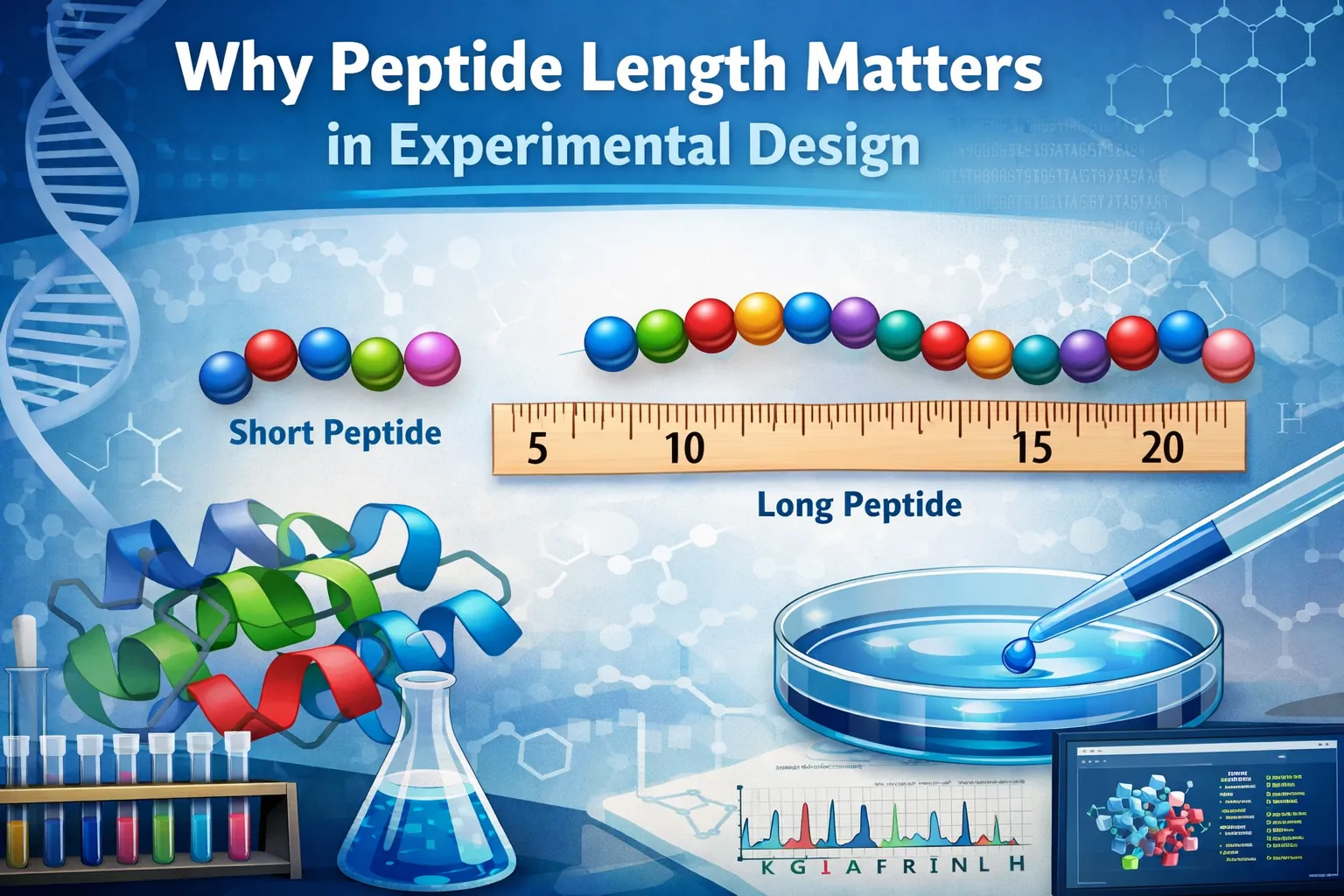

Peptide length affects structure, stability, biological activity, cost, and predictability. Short peptides are flexible and easier to synthesize but less stable. Long peptides are more structured and sometimes more biologically robust, but they are harder to produce and may aggregate.
Peptides are chains of amino acids, but not all chains behave the same. A peptide with 6 amino acids does not act like one with 35. In experiments, that difference can change everything from binding strength to degradation speed.
In biological systems, peptide length is not random. Research on proteasome digestion shows that many naturally generated peptides average around 8 amino acids, although the full range can extend much wider. This tells us something important. Short peptides are not artificial lab creations. They are part of normal biology.
But in the lab, the choice between short and long peptides depends on your goal.
If you are mapping a binding site, short fragments may help isolate the active region. If you want to mimic a natural signaling molecule, a longer sequence may preserve structural features needed for function.
Length influences:
- Structural folding
- Binding specificity
- Resistance to proteases
- Solubility and aggregation
- Manufacturing yield
Ignoring peptide length when designing experiments often leads to inconsistent results. The sequence matters, but length shapes how that sequence behaves.
Natural Peptide Length Distribution in Biology
Most biologically generated peptides are short, often around 6 to 10 amino acids on average, but longer fragments also exist depending on enzymatic processing.
Inside cells, proteins are constantly being broken down. The proteasome acts like a molecular recycling machine. It does not cut proteins into random sizes. Instead, it produces peptides within certain preferred length ranges.
Studies have shown that many proteasome products cluster around single digit lengths, especially near 8 amino acids. This length range is biologically meaningful because it fits well into immune system presentation pathways such as MHC class I binding.
What does this mean for experiments?
It means that short peptides are not unnatural simplifications. They often reflect real biological intermediates. When researchers test fragments of larger proteins, they are sometimes studying forms that already exist inside cells.
However, longer peptides also appear during partial digestion. These can retain secondary structure and partial folding characteristics. That structural retention can influence how they interact with receptors or enzymes.
So biology uses both short and longer peptides. The context determines which form dominates.
How Researchers Define “Short” vs “Long” Peptides
Short peptides typically contain fewer than 10 to 15 amino acids. Long peptides often range from 20 to 50 amino acids. The definition varies depending on research context.
There is no strict universal boundary between short and long peptides. Definitions shift depending on the field.
In immunology, an 8 to 10 amino acid peptide may be considered standard length. In structural biology, anything under 15 residues is often labeled short because it rarely forms stable secondary structure alone.
Long peptides usually begin around 20 amino acids. At this length, alpha helices or beta sheet tendencies start to appear. Folding becomes more predictable. Intramolecular interactions can stabilize the sequence.
This structural difference is critical.
Short peptides:
- Often remain highly flexible
- May adopt multiple conformations
- Are more sensitive to environmental changes
- Are harder to model accurately using computational tools
Long peptides:
- Can form stable secondary structure
- Sometimes show partial folding
- May resist protease degradation better
- Can display defined functional domains
Recent computational studies also show that predicting short peptide structure is surprisingly difficult. Their flexibility means they can shift shapes easily, which complicates modeling and reproducibility.
In experiments, the question is not just “How long is it?”
The real question is: “What structural behavior do I need for my hypothesis?”
Choosing length is a strategic decision. It shapes stability, activity, and interpretation.
Structural Behavior Differences
Peptide length strongly influences structure. And structure determines function.
Short peptides are usually flexible. They do not always form stable alpha helices or beta sheets on their own. Instead, they exist as dynamic molecules that shift between multiple conformations. This flexibility can be helpful in some experiments, especially when studying minimal binding motifs. But it can also reduce reproducibility because the peptide may adopt different shapes depending on temperature, solvent, concentration, or binding partner.
Recent computational research has highlighted how difficult it is to predict the structure of short peptides accurately. Because they lack long range stabilizing interactions, small environmental changes can dramatically alter their conformation. Modeling tools that work well for larger proteins do not always perform reliably for short sequences. This creates uncertainty when experimental design depends on predicted structure.
Long peptides behave differently. Once a peptide reaches 20 to 30 amino acids, intramolecular interactions begin to stabilize secondary structure. Hydrogen bonds, hydrophobic packing, and backbone constraints promote helix or sheet formation. Even if full tertiary folding is absent, partial structural organization becomes more likely.
This structural stability has several consequences:
- Binding interfaces may be more defined.
- Functional residues may be spatially oriented in a predictable way.
- Protease resistance can improve.
- Experimental reproducibility often increases.
However, longer peptides introduce new challenges. They may aggregate at higher concentrations. They may fold incorrectly outside their natural protein context. And structural complexity can make interpretation harder if multiple domains contribute to activity.
In short, short peptides offer flexibility and simplicity. Long peptides offer structure and organization. The right choice depends on whether your experiment needs dynamic minimal motifs or stable structural mimicry.
Biological Activity: Fragment vs Full-Length Peptides
One of the most common experimental questions is whether a short fragment can reproduce or even exceed the activity of the full length peptide.
The answer is not simple.
In many proteins, biological activity is concentrated in a small region known as a functional motif. If that motif is isolated correctly, a short peptide fragment can retain binding ability. In some cases, truncation removes inhibitory regions, exposing active residues more clearly. That can make the fragment appear more potent in vitro.
This idea is often tested by synthesizing overlapping fragments of a longer peptide and screening for activity. Researchers sometimes discover that an 8 to 12 amino acid fragment binds more tightly than the original 30 amino acid sequence. Why would that happen?
Several mechanisms can explain it:
- The full length peptide may fold in a way that partially hides the active site.
- Larger sequences may introduce steric hindrance.
- Flexible fragments may adapt more easily to the target surface.
- Truncation may remove destabilizing residues.
However, fragment activity can also be misleading.
A short peptide might bind strongly under controlled laboratory conditions but fail in biological systems due to rapid degradation. Longer peptides may retain moderate binding but demonstrate greater stability and functional persistence in cells or serum.
Biology also reminds us that natural peptide processing produces fragments of defined length. Proteasomal degradation often yields peptides within specific size ranges that are biologically active. This supports the idea that short fragments are not artificial constructs but can represent real biological intermediates.
At the same time, some biological functions require structural context that only longer sequences can provide. Signal peptides, receptor interacting domains, and conformational epitopes may lose activity when shortened.
So the decision to use a fragment or a full length peptide should be guided by the biological question:
- Are you identifying the minimal binding region?
- Are you replicating physiological signaling?
- Are you optimizing potency?
- Or are you modeling natural structure?
Fragment screening is powerful. But functional validation in biologically relevant systems is essential before drawing conclusions.
Stability in Experimental Systems
Peptide length directly affects how long a molecule survives in experimental conditions.
Short peptides are generally more vulnerable to proteases. In serum, cell culture media, or tissue extracts, enzymatic degradation can occur quickly. A 6 to 8 amino acid fragment may lose activity within minutes if not chemically stabilized. This rapid breakdown can distort dose response results, especially when experiments rely on sustained exposure.
Why are short peptides more sensitive?
They lack internal structural protection. Without stable folding or secondary structure, cleavage sites remain fully exposed. Proteases can access peptide bonds easily. This is one reason why researchers often modify short peptides using terminal protection, cyclization, or amino acid substitution to increase stability.
Long peptides often show improved resistance. Partial folding can shield certain cleavage sites. Intramolecular interactions can slow enzymatic access. In some cases, longer peptides demonstrate extended half life in serum compared to minimal fragments.
However, longer does not always mean stable.
Long peptides may contain multiple vulnerable cleavage points. If they misfold or remain partially unfolded, proteases can still act efficiently. Stability also depends on sequence composition, not just length. Peptides rich in certain residues may degrade faster regardless of size.
From an experimental perspective, stability influences:
- Observed potency
- Reproducibility across replicates
- Time dependent assay outcomes
- In vivo translation of in vitro findings
When comparing short and long peptides, researchers must consider degradation kinetics carefully. A fragment may look weak simply because it disappears quickly. A longer peptide may appear stronger because it persists longer.
Without measuring half life, conclusions about activity can be misleading.
Solubility, Aggregation, and Formulation
Peptide behavior in solution is often underestimated, but it plays a major role in experimental outcomes.
Short peptides are usually more soluble, especially if they contain charged residues. Their small size and limited hydrophobic surfaces reduce aggregation risk at moderate concentrations. This makes them easier to handle in early screening experiments.
But high concentration effects can still occur. Some short peptides self associate, particularly if hydrophobic residues cluster within the sequence. Even small molecules can aggregate under certain buffer conditions.
Long peptides present more complex challenges.
As sequence length increases, hydrophobic regions become more likely. These regions can promote self association and aggregation. Aggregation not only reduces effective concentration but may also alter biological readouts. Precipitation, turbidity, or invisible oligomer formation can interfere with binding assays.
Recent formulation research has also shown that short peptides can influence protein stability when used as excipients. Certain dipeptides or tripeptides can reduce protein aggregation under specific conditions. However, these effects are highly context dependent. The same peptide that stabilizes one protein may destabilize another depending on concentration, pH, and ionic environment.
This highlights an important principle.
Peptide behavior is not just about sequence or length. It is also about environment.
When choosing between short and long peptides in experiments, researchers should evaluate:
- Buffer composition
- pH sensitivity
- Concentration range
- Storage stability
- Freeze thaw tolerance
Aggregation can falsely reduce activity. Insolubility can distort dose response curves. And unnoticed formulation effects can lead to conflicting data between laboratories.
Length influences these properties, but so does composition. A well designed experiment accounts for both.
Computational Modeling Considerations
Computational tools are widely used to predict peptide structure and binding behavior. But peptide length changes how reliable those predictions are.
Short peptides are surprisingly difficult to model. Because they are highly flexible, they do not stay in one fixed shape. Instead, they shift between many conformations in solution. A modeling program may predict one stable structure, but in reality the peptide may exist as a dynamic ensemble.
Recent research comparing modeling approaches shows that prediction accuracy depends heavily on peptide size and composition. Tools that perform well for structured proteins may struggle with short, disordered sequences. Hydrophobic short peptides may transiently collapse, while hydrophilic ones may remain extended. This variability makes computational interpretation challenging.
Another issue is context. A short peptide may not adopt its biologically relevant structure until it binds to a target. In isolation, modeling may not capture that induced fit behavior. As a result, predicted binding strength or orientation can be misleading.
Long peptides are generally easier to model than short ones, but they still present limitations. Once a sequence exceeds 20 to 30 amino acids, secondary structure prediction becomes more reliable. Alpha helices and beta sheet tendencies are easier to detect. Structural motifs may be preserved.
However, long peptides may partially fold in unpredictable ways outside their native protein context. If the peptide is originally part of a larger protein, removing surrounding domains can change its structure. Modeling such fragments requires careful interpretation.
In experimental planning, computational results should guide hypotheses, not replace validation. Short peptides require cautious interpretation. Long peptides demand awareness of context loss.
Modeling is helpful, but length dependent uncertainty must be acknowledged.
Cost and Synthesis Efficiency
Peptide length has a direct impact on cost, yield, and practical feasibility.
Most laboratory peptides are synthesized using solid phase peptide synthesis. Each additional amino acid requires another coupling step. As length increases, the risk of incomplete reactions grows. This can reduce overall yield and increase purification complexity.
Short peptides are faster and cheaper to synthesize. Fewer coupling cycles mean higher efficiency and fewer side products. Purification is usually simpler, and turnaround time is shorter. For screening experiments that require many variants, short peptides are often more practical.
Long peptides are more expensive. With every added residue, synthesis efficiency decreases slightly. Over 30 to 40 amino acids, yield loss becomes significant. Impurities such as truncated sequences may appear, requiring more rigorous purification methods like high performance liquid chromatography.
Long peptides also increase analytical demands. Confirming identity and purity requires more detailed mass spectrometry and quality control. This adds both time and cost.
However, cost should not be the only deciding factor. If a longer sequence is required to maintain functional structure, choosing a short fragment simply to save money can compromise the experiment.
In large scale or translational research, budget considerations become even more important. Stability modifications, cyclization, or chemical stabilization of short peptides may raise costs. Likewise, complex long peptides may require optimization to improve yield.
From a practical standpoint:
- Short peptides support rapid screening and high throughput studies.
- Long peptides may be necessary for structural or functional fidelity.
- Experimental goals should justify synthesis complexity.
Length is not just a biological variable. It is also an economic one.
Choosing the Right Length for Your Study
Selecting peptide length is not a theoretical decision. It should match the biological question you are trying to answer.
If your goal is to identify the minimal binding region of a protein, short peptides are often the starting point. Fragment scanning allows researchers to test overlapping sequences and pinpoint active motifs. This approach is common in epitope mapping, receptor binding studies, and interaction disruption experiments. Short peptides reduce complexity and help isolate functional residues.
However, minimal activity does not always mean biological relevance. A fragment that binds in vitro may lack the structural stability needed in cellular systems. If your experiment aims to mimic natural signaling, preserve conformational structure, or study multi-residue interactions, a longer peptide may be more appropriate.
In immunology, short peptides are often sufficient for antigen presentation studies because natural processing produces peptides in specific size ranges. In contrast, structural biology experiments that depend on helix formation or domain integrity may require longer sequences to maintain proper folding tendencies.
Here are practical decision points researchers often consider:
- Are you testing a minimal interaction site or a full signaling region?
- Does biological activity depend on secondary structure?
- Will the experiment occur in protease rich environments?
- Is high throughput screening required?
- Is structural modeling central to your design?
Sometimes the most effective strategy is sequential. Start with longer peptides to confirm activity, then progressively shorten the sequence to identify the essential core. This approach balances structural integrity with mechanistic precision.
Peptide length should serve the hypothesis. It should not be chosen by convenience alone.
Advantages and Limitations Summary
Below is a structured comparison to guide experimental planning:
| Feature | Short Peptides | Long Peptides |
| Typical Length | Below 10 to 15 amino acids | 20 to 50 amino acids |
| Structural Stability | Highly flexible, often unstructured | More likely to form stable secondary structure |
| Modeling Predictability | Difficult due to conformational variability | More reliable but still context dependent |
| Protease Resistance | Generally lower | Often higher, but sequence dependent |
| Solubility | Usually good, but hydrophobic sequences may aggregate | Greater aggregation risk |
| Synthesis Cost | Lower, faster production | Higher, more complex purification |
| Screening Utility | Excellent for high throughput studies | Less practical for large variant libraries |
| Biological Context Mimicry | May lack full structural features | Better at preserving functional domains |
This comparison highlights an important principle. Neither short nor long peptides are inherently superior. Each offers strengths and weaknesses that influence experimental interpretation.
Choosing wisely requires balancing structural needs, biological context, stability, cost, and reproducibility.
Future Directions in Peptide Length Optimization
Peptide research is moving toward precision. Instead of choosing between very short or very long sequences, scientists are now focusing on optimized length.
One important trend is the design of stabilized short peptides. Researchers are introducing chemical modifications such as cyclization, stapling, and terminal protection to improve resistance against degradation. These strategies help short peptides maintain activity while increasing half life in biological systems.
Another direction is hybrid design. Instead of testing a full length natural sequence, scientists engineer peptides that combine minimal active motifs with structural stabilizing elements. This allows the molecule to retain binding specificity while gaining improved stability and solubility.
Computational advances are also shaping the field. Machine learning models are now being trained specifically on short peptide datasets, not just full proteins. This is important because short peptides behave differently from folded proteins. Improved modeling may reduce uncertainty in experimental design and help predict which sequence length is most appropriate before synthesis.
Fragment based screening is becoming more systematic as well. Rather than testing random truncations, researchers design rational libraries guided by structural data. This reduces wasted effort and increases the likelihood of identifying functional minimal motifs.
There is also growing interest in context dependent design. Instead of asking whether short or long peptides are better in general, the question is becoming more specific:
Better for which receptor
Better under which environmental conditions
Better for which delivery system
The future is not about length alone. It is about matching length to function, environment, and stability requirements.
Conclusion
Short peptides and long peptides behave differently in experiments because length shapes structure, stability, predictability, and cost.
Short peptides offer flexibility, rapid synthesis, and efficient screening. They are often useful for identifying minimal binding regions and studying core functional motifs. However, they can degrade quickly and are harder to model accurately due to their structural variability.
Long peptides provide greater structural organization and sometimes improved biological persistence. They may better preserve natural functional domains and secondary structure. Yet they introduce higher synthesis cost, potential aggregation, and more complex interpretation.
There is no universal answer to which is better.
The right choice depends on experimental purpose. If the goal is mechanistic precision, fragments may reveal the essential sequence. If the goal is biological fidelity, longer peptides may be required.
Effective experimental design does not treat peptide length as a secondary detail. It treats it as a central variable.
Researchers who deliberately evaluate structural needs, degradation risk, modeling limitations, and synthesis constraints are more likely to generate reproducible and meaningful data.
In peptide science, size is not just a number. It is a strategic decision.
FAQs
Q. Can a short peptide be more active than a long peptide?
Ans: Yes, in some cases. If the biological activity is concentrated within a small motif, a short fragment can retain or even enhance binding. Truncation may remove inhibitory regions and expose key residues. However, higher in vitro potency does not always translate to better stability or performance in biological systems.
Q. Are short peptides always less stable than long peptides?
Ans: Not always, but they are generally more vulnerable to protease degradation. Because they lack stabilizing secondary structure, cleavage sites are often exposed. Chemical modifications such as cyclization or terminal protection can improve their stability.
Q. Why are short peptides harder to model computationally?
Ans: Short peptides are highly flexible and can adopt multiple conformations in solution. Many prediction tools are optimized for structured proteins, not small dynamic sequences. This makes computational results less reliable without experimental validation.
Q. When should I choose a long peptide instead of a short fragment?
Ans: Long peptides are preferable when structural context matters. If the activity depends on secondary structure, domain integrity, or conformational stability, a longer sequence may better reflect biological function.
Q. Is peptide length more important than amino acid sequence?
Ans: Both matter. The sequence determines chemical properties and binding potential. Length influences structural behavior, stability, and experimental reproducibility. A well designed study considers sequence and length together.
Sources
- https://pmc.ncbi.nlm.nih.gov/articles/PMC12566840/
- https://www.jbc.org/article/S0021-9258(19)84147-9/pdf
- https://www.researchgate.net/post/Compare-activity-of-peptide-fragments-vs-full-peptide
- https://www.nature.com/articles/s41598-025-16866-w