


Learning how to read a peptide coa (Certificate of Analysis) requires looking beyond the bold “99% Purity” text at the top of the page and analyzing the raw analytical data provided by an independent testing facility. A legitimate Certificate of Analysis is an immutable technical document issued by an accredited laboratory that details the exact chemical identity, purity profile, and quantitative mass of a specific peptide batch through rigorous testing methodologies.
The research peptide market operates with minimal regulatory oversight, leading many vendors to rely on recycled, altered, or outright fabricated documentation. To ensure safety, experimental reproducibility, and chemical integrity, researchers must conduct a forensic audit of every CoA. This involves cross-referencing raw chromatograms, verifying theoretical molecular weights against mass spectrometry data, and confirming third-party laboratory credentials.
Anatomy of a Legitimate Peptide CoA: What Must Be Present
A authentic Certificate of Analysis from a certified testing facility must contain non-negotiable structural elements. If any of these foundational markers are missing, incomplete, or obscured, the document cannot be relied upon as proof of chemical quality.
First, examine the laboratory header. A valid report prominently displays the full legal name, physical address, and contact information of the performing laboratory, alongside its certification credentials. Look specifically for ISO/IEC 17025 accreditation—the international standard for testing and calibration laboratories. Accreditations should include a verifiable certificate number issued by a recognized body such as A2LA, ANAB, or PJLA.
A vendor logo stamped over the lab details or a complete absence of the testing entity’s branding is an immediate operational red flag.
Second, the document must establish an unbroken chain of custody through strict sample identification metrics. This includes a unique sample tracking ID, a clear batch or lot number, the exact date the sample was received, and the date the analytical report was finalized. The batch number listed on the CoA must match the physical label on the peptide vial with total precision.
If a vendor provides a CoA dated eighteen months prior or links a single report to multiple distinct production runs, the data is scientifically irrelevant for your specific batch.
Finally, the document must feature accountability sign-offs. Look for the legible name, title, and digital or hand-written signature of the analytical chemist who performed the run, as well as the Quality Assurance (QA) manager who approved the release.
Modern accredited labs typically include a dynamic QR code or a direct web link that routes to the laboratory’s secure domain, allowing you to view the original PDF stored on their server and verify that the document has not been manipulated in graphics software.
HPLC Purity Analysis: Reading Retention Times and Peak Areas
High-Performance Liquid Chromatography (HPLC) is the gold-standard analytical method used to separate, identify, and quantify the chemical purity of a peptide. The output of this test is an HPLC chromatogram—a two-dimensional graph plotting signal intensity (measured in milli-absorbance units, or mAU) on the vertical Y-axis against retention time (measured in minutes) on the horizontal X-axis.

Understanding retention time is critical. As the liquid mobile phase carries the dissolved peptide through a packed stationary column under high pressure, different chemical compounds interact with the packing material with varying intensity. The time it takes for a compound to travel through the column and reach the ultraviolet (UV) detector is its retention time.
Under defined run parameters—such as column type, temperature, flow rate, and mobile phase gradient—a specific peptide will always elute at a predictable retention time.
Purity percentage is calculated using the relative peak area integration method. The primary peak represents the target peptide. The analytical software measures the integrated area beneath this dominant peak and divides it by the total area under all detected peaks combined across the run. For instance, if the total integrated area across all peaks is 1,000 mAU·s and the main peptide peak accounts for 985 mAU·s, the reported purity is 98.5%.
| Peak Type | Retention Time Behavior | Chemical Significance |
|---|---|---|
| Target Peptide Peak | Matches expected literature benchmark | The intended intact peptide sequence. |
| Pre-Elution Peaks | Elutes earlier than main peak | Highly polar impurities, truncated sequences, or residual reagents. |
| Post-Elution Peaks | Elutes later than main peak | Non-polar impurities, hydrophobic aggregates, or protecting groups. |
| Baseline Noise | Continuous minor fluctuations | Mobile phase background, column bleed, or micro-level degradation. |
A common misinterpretation is assuming that a reported “99% HPLC Purity” guarantees a pristine sample. HPLC purity reflects relative chemical sequence integrity among UV-absorbing species; it does not account for non-UV-absorbing contaminants, heavy metals, residual solvents, or moisture content.
Furthermore, dishonest vendors can adjust the baseline integration settings in the testing software—setting a high threshold cutoff that deliberate ignores secondary baseline peaks—to artificially inflate a 92% pure sample into a report that claims 99% purity. Always inspect the raw chromatogram baseline visual to ensure all minor peaks are fully integrated down to the flat baseline.
Mass Spectrometry (LC-MS): Verifying Molecular Mass Against Theory
While HPLC measures sample purity, it cannot confirm chemical identity. A non-target molecule or a scrambled amino acid sequence could coincidentally share the exact same HPLC retention time as your desired peptide. Mass Spectrometry (MS)—typically coupled with liquid chromatography as LC-MS—is required to definitively verify molecular identity by measuring the mass-to-charge ratio (m/z) of the molecule’s ions.
To audit a mass spectrum, you must first calculate or look up the theoretical monoisotopic or average molecular weight (Da, or Daltons) of your target sequence. On the LC-MS spectrum output, you will observe mass signal spikes. Because electrospray ionization (ESI) usually imparts positive charges onto the peptide during analysis, the mass spectrometer measures adducts and multi-charged states rather than solely uncharged molecules.
In high-molecular-weight or complex synthetic peptides, you will frequently see multi-charge states represented as [M+H]⁺ (single positive charge), [M+2H]²⁺ (double charge), or [M+3H]³⁺ (triple charge). To calculate the neutral molecular mass (M) from a doubly charged peak [M+2H]²⁺, subtract the mass of two protons (roughly 2.016 Da) from the observed m/z value and multiply by two.
The resulting calculated mass should match the theoretical sequence mass within the instrument’s margin of error—typically within 0.01 to 0.5 Da depending on whether a high-resolution Q-TOF or standard single-quadrupole mass spectrometer was used.
Pay close attention to secondary mass peaks present in the spectrum. A cluster of minor peaks spaced 16 Da above the primary target peak indicates peptide oxidation (the addition of an oxygen atom, commonly occurring at methionine or tryptophan residues). Peaks appearing 42 Da higher indicate unwanted acetylation. Furthermore, synthetic peptides are routinely isolated as trifluoroacetate (TFA) or acetate salts.
The presence of residual TFA counter-ions can alter observed spectrum peaks and must be factored into total mass calculations, as heavy TFA retention reduces the actual net peptide content by mass relative to total powder weight.
Purity vs. Fill Quantity: Why ‘99% Pure’ Does Not Mean Full Dose
A common misinterpretation when reading a peptide CoA is confusing chromatographic purity with net peptide content. An HPLC result showing 99% purity simply indicates that 99% of the UV-absorbing material detected at a specific wavelength (typically 214 nm or 220 nm) corresponds to the targeted peptide molecule, rather than truncated sequences or synthesis side-products. It does not mean the vial contains 99% active peptide by total weight.
Lyophilized (freeze-dried) peptide vials almost always contain bulking agents, most commonly mannitol or trehalose, added during processing to form a visible cake and stabilize the cake structure. Furthermore, synthetic peptides exist as salts—typically trifluoroacetate (TFA) or acetate salts—and retain bound counterions along with residual moisture.
A 5 mg vial of a peptide with a reported 99% HPLC purity may actually consist of 1 mg of active peptide base, 0.5 mg of counterions and moisture, and 3.5 mg of mannitol filler.
To determine the true mass of the active compound, analytical facilities perform Nitrogen Determination (Dumas method) or Amino Acid Analysis (AAA). AAA quantifies the exact molar concentration of constituent amino acids following acid hydrolysis, revealing the true net peptide content. When auditing a CoA for dosage critical applications, look for a explicit “Net Peptide Quantity” or “Content by AAA” metric.
Relying solely on HPLC peak area integration without accounting for salt content and bulking mass will lead to significant under-dosing in Research settings.
Step-by-Step Audit: How to Cross-Verify a CoA with the Testing Facility
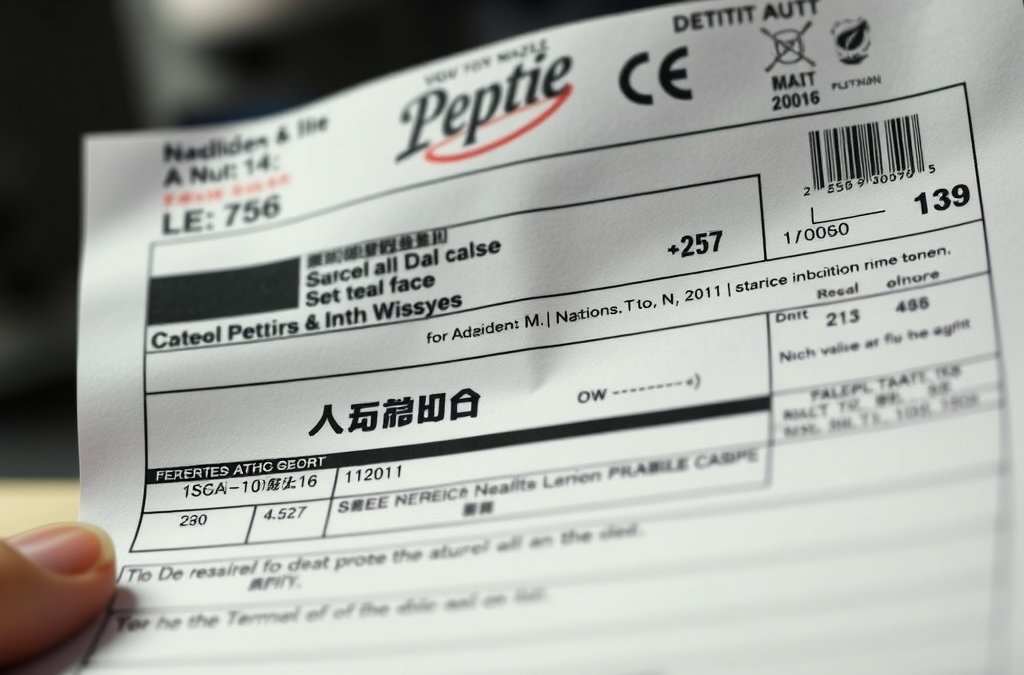
- Locate the Unique Report Identifier and Verification Mechanism: Inspect the header or footer of the CoA for a unique task number, report key, or cryptographic QR code issued by the accredited third-party laboratory (such as Janoshik Analytical, MZ Biolabs, or Marquis Labs).
- Query the Testing Facility’s Public Database Directly: Do not rely on the URL embedded inside a vendor-provided QR code, as fraudulent vendors can redirect QR codes to look-alike domain names. Manually navigate to the laboratory’s official domain and enter the report key into their verification portal.
- Match Key Analytical Parameters: Compare the online record against the provided document. Verify that the recorded mass spectra peak ($m/z$), expected theoretical mass, measured HPLC retention time, batch code, and client name match the official record character for character.
- Confirm Batch and Lot Specificity: Verify that the lot number printed on the vial physical label directly mirrors the lot number assigned on the analytical report. A valid CoA is non-transferable across different synthesis runs; a report dated six months prior to purchase likely reflects a depleted batch.
- Contact the Lab via Secure Channels for Unindexed Reports: If the laboratory does not host a public lookup portal, email their quality assurance department directly with the PDF attachment and task number, requesting confirmation that the document was generated by their instrument software without post-issuance alteration.
Red Flags and Forgery Tactics in the Peptide Industry
- Recycled Task Numbers and Mismatched Dates: Vendors frequently overlay new batch numbers onto old analytical runs. Look for discrepancies between the sample submission date, analysis completion date, and the order date.
- Photoshop Artifacts Around Spectral Peaks: Inspect the resolution around the HPLC chromatogram baseline and MS spectra. Inconsistent pixelation, altered font geometry in axis labels, or mismatched background noise levels indicate graphic manipulation of peak areas or retention times.
- Omission of Raw Mass Spectrometry Data: A legitimate CoA must include the LC-MS spectral trace showing the target mass-to-charge ratio ($m/z$). A report that provides only an HPLC percentage table without molecular weight confirmation fails to prove the identity of the peak.
- In-House Testing Claims Without Raw Data Files: Certificates generated internally by vendor personnel rather than ISO/IEC 17025 accredited third-party facilities carry high inherent bias. If an internal CoA is supplied, request the raw instrument data files (.RAW, .D, or .LCD formats).
- Absence of Heavy Metals and Bioburden Panels: High purity on HPLC does not rule out toxic processing catalysts or biological contaminants. High-grade analytical audits require ICP-MS panels for heavy metals (lead, arsenic, mercury, cadmium) and endotoxin quantification.
Key Takeaways
- HPLC purity measures the relative abundance of the target sequence against impurities, not the total weight of the peptide in the vial.
- Net peptide content must be verified through Amino Acid Analysis (AAA) to account for lyophilization bulking agents and counterion salts.
- Always bypass vendor QR links and verify report keys directly on the independent testing laboratory’s official domain.
- A complete peptide CoA must contain both HPLC chromatograms for purity and LC-MS spectra for identity confirmation.
Watch: How to Read a Peptide COA (certificate of analysis)
Frequently Asked Questions
What is the difference between TFA salt and Acetate salt on a CoA?
TFA (trifluoroacetate) and acetate represent the counterions bound to basic amino acid residues during peptide synthesis. TFA is standard in solid-phase synthesis but can exert cellular toxicity; acetate counterions are milder for biological applications. The CoA should specify which salt form is present.
Can a vendor fake a QR code on a CoA?
Yes, vendors can generate QR codes that redirect to cloned websites mimicking analytical laboratories. Always read the destination domain name carefully or manually navigate to the verified laboratory portal to input the document key directly.
Why does my peptide CoA show a higher mass than the theoretical mass?
Peptides analyzed via Electrospray Ionization Mass Spectrometry (ESI-MS) form adducts with cations in the solvent matrix. A higher mass peak often corresponds to protonated species ($[M+H]^+$), sodium adducts ($[M+Na]^+$), or potassium adducts ($[M+K]^+$) rather than an incorrect synthesis.
How long is a peptide CoA valid for a given batch?
A CoA reflects the state of a specific batch at the time of testing. Because lyophilized peptides degrade over time through hydrolysis or oxidation, a CoA older than 12 months may no longer reflect current purity unless stored under validated ultracold conditions.
Is endotoxin testing required on every peptide CoA?
Endotoxin testing (LAL assay) is essential for compounds intended for parenteral laboratory research to ensure the absence of lipopolysaccharides. While not universally included on standard chemical purity CoAs, it is a critical safety parameter for biological assays.
Conclusion: Conducting Rigorous Analytical Audits
Reading a peptide Certificate of Analysis requires looking past superficial percentage figures and auditing the underlying analytical data. By validating raw HPLC integration tables, cross-checking mass-to-charge ratios against theoretical models, and verifying report keys directly with independent testing laboratories, researchers can reliably verify material identity, purity, and safety profiles.
Prioritize suppliers that provide transparent, lab-verifiable CoA documentation alongside net peptide content analyses for every distinct synthesis lot. This information is provided strictly for educational and analytical research purposes, not as medical advice; personal health decisions and clinical protocols must always be guided by a licensed health care professional.