
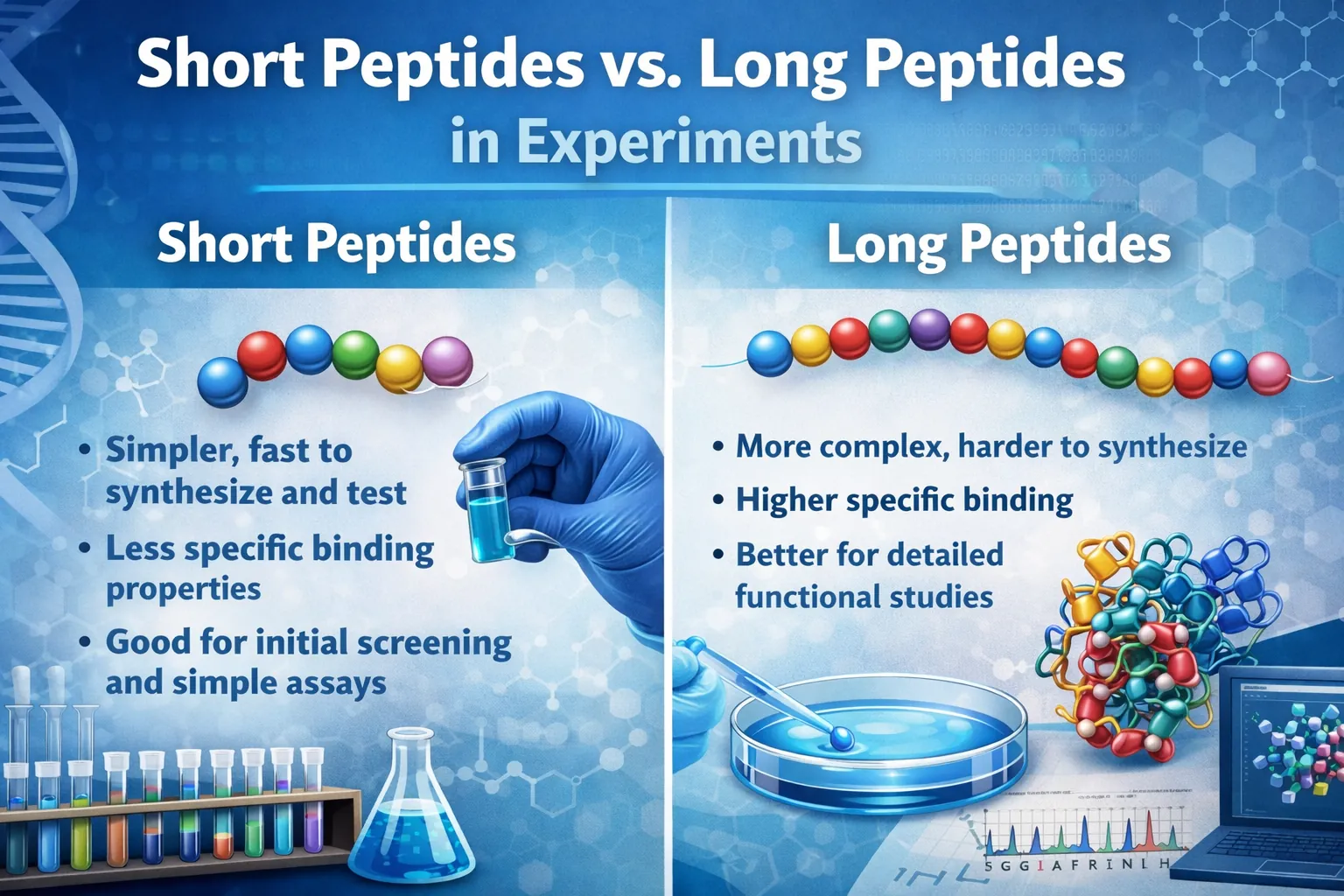

At first glance, peptide length looks like a simple number. Five amino acids. Fifteen amino acids. Thirty amino acids. What difference could it really make?
In laboratory experiments, it makes a serious difference.
Peptide length affects almost everything that happens after you open the vial. It influences how the peptide folds, how easily it dissolves, how stable it remains during storage, how clean the purification profile looks, and even how reproducible your assay results will be.
Length Changes Structure
Short peptides often behave like flexible strings. They may not hold stable secondary structures in solution. In contrast, longer peptides are more likely to form alpha helices, beta sheets, or partial folded regions. Even small increases in length can shift conformational behavior.
Why does that matter?
Because structure affects binding. A short sequence may contain the core binding motif, but a longer sequence may provide structural context that improves or changes interaction strength.
Length Changes Synthesis Success
Peptides used in research are commonly produced through solid phase peptide synthesis. As sequences grow longer, coupling efficiency drops. Small inefficiencies add up.
A 10 amino acid peptide with 99 percent coupling efficiency per step still has high final yield. But stretch that to 30 amino acids and the accumulated error risk becomes significant. Incomplete couplings, deletion sequences, and side reactions increase.
That means longer peptides typically require more purification effort. Yield may drop. Cost increases. Batch variability becomes more likely.
So peptide length is not just biology. It is manufacturing reality.
Length Changes Purity Interpretation
When you see a purity value on a certificate of analysis, the number alone does not tell the full story. A 95 percent pure short peptide may contain simple truncated fragments. A 95 percent pure long peptide may contain structurally similar impurities that are harder to separate and identify.
Longer sequences produce more possible byproducts. Overlapping peaks in HPLC traces are more common. Mass spectrometry data can become more complex to interpret.
The longer the peptide, the more careful the analysis must be.
Length Changes Experimental Risk
Short peptides are usually easier to dissolve and handle. They often diffuse faster in solution. They are commonly used in screening studies, motif mapping, and quick interaction assays.
Long peptides can aggregate depending on sequence composition. Hydrophobic segments may stick to plasticware. Solubility may vary based on buffer conditions.
These handling differences directly affect concentration accuracy. And concentration accuracy affects reproducibility.
In other words, peptide length quietly influences data quality.
Definitions That Labs Use
There is no single universal rule that defines short versus long peptides. The classification depends on context, purpose, and handling behavior.
Still, laboratories tend to use practical working definitions.
What Are Short Peptides?
In experimental settings, short peptides often refer to sequences containing roughly 2 to 15 amino acids. Some labs extend that boundary to 20 residues, especially in receptor binding or epitope mapping studies.
Short peptides are commonly used for:
- Minimal binding motif identification
- Enzyme substrate studies
- Rapid screening assays
- Structure activity relationship experiments
They are typically easier to synthesize, purify, and scale. Because of their smaller size, they often dissolve quickly in aqueous buffers, though sequence composition still matters.
Short peptides may lack stable secondary structure in isolation. They often behave dynamically in solution. That flexibility can be useful in certain interaction models.
But flexibility can also reduce specificity in some systems.
What Are Long Peptides?
Long peptides generally refer to sequences above 20 amino acids, often extending into the 30 to 50 residue range. Beyond that point, the molecule begins to approach small protein territory.
Long peptides are often selected when:
- Structural context is important
- Multi site binding interactions are studied
- Immune response modeling requires extended epitopes
- Partial domain mimics are needed
Longer sequences are more likely to form partial folded regions. This can improve biological relevance in some experimental systems.
However, increased length introduces:
- Higher synthesis complexity
- Greater purification difficulty
- More possible impurity variants
- Increased handling sensitivity
In some fields, such as immunology research, synthetic long peptides are intentionally used to provide broader processing or presentation behavior compared to minimal short epitopes. In signaling research, longer peptides may better mimic natural regions of proteins.
Why the Boundary Is Flexible
The dividing line between short and long peptides is not strict because function does not scale linearly with length.
A 12 residue peptide can be functionally complete in one system. A 25 residue peptide may be required in another to preserve structural context.
Instead of asking, “What is the official cutoff?”, researchers should ask:
What does the experiment require?
Is minimal binding enough?
Is structural mimicry important?
Is rapid screening the goal?
Is reproducibility under tight purity control essential?
Peptide length is a design decision. Not a label.
Short vs Long Peptides: Side-by-Side Experimental Comparison
When a keyword includes “vs,” researchers expect clarity. So instead of vague statements, let’s look at what actually changes in the lab when peptide length increases.
Below is a practical comparison focused on real experimental impact.
Core Experimental Differences
| Factor | Short Peptides | Long Peptides | Experimental Impact |
| Typical Length | ~2–15 amino acids | ~20–50+ amino acids | Length affects structure and synthesis complexity |
| Synthesis Efficiency | Higher success rates | Lower cumulative yield | Longer chains accumulate coupling errors |
| Purification Difficulty | Usually simpler | Often more challenging | More deletion and truncated variants appear |
| HPLC Profile | Cleaner, sharper peaks | Broader or overlapping peaks possible | Peak interpretation becomes harder |
| Mass Spectrometry | Easier to confirm identity | More fragment possibilities | Data analysis becomes more complex |
| Solubility | Often dissolves quickly | May aggregate depending on sequence | Working concentration accuracy varies |
| Structural Stability | Usually flexible | May form partial secondary structure | Structure influences binding behavior |
| Cost | Lower | Higher | Budget planning matters in large studies |
| Batch Variability | Typically lower | Potentially higher | Reproducibility risk increases with length |
Now let’s interpret this table instead of just reading it.
Why Synthesis Efficiency Drops With Length
Peptides are assembled one amino acid at a time. Each step has a small chance of incomplete coupling. Even if efficiency is very high per step, small errors compound as the chain grows.
For example, a 10-residue peptide may tolerate minor inefficiencies without major yield loss. A 35-residue peptide accumulates those risks across many more steps.
That leads to:
- Lower crude yield
- More truncated fragments
- Increased purification time
And more purification means more cost.
Why Purity Numbers Can Mislead
A short peptide at 95 percent purity often contains simple deletion sequences that separate clearly during chromatography.
A long peptide at 95 percent purity may contain structurally similar byproducts that co-elute closely. The chromatogram might look acceptable, but impurity complexity is higher.
So purity percentage alone does not scale equally across lengths.
Handling Differences That Affect Assays
Short peptides usually:
- Diffuse quickly
- Dissolve faster
- Show less aggregation risk
Long peptides can:
- Form partial folded regions
- Aggregate in certain buffers
- Adhere to plastic surfaces
These physical behaviors affect effective concentration. And effective concentration affects reproducibility.
So the “vs” question is not about which is better overall. It is about matching peptide length to experimental demands.
Structural and Conformational Differences
Peptide length directly influences structural behavior in solution. And structure drives function.
Short Peptides: Flexibility and Dynamic Motion
Short peptides often lack stable secondary structure in aqueous solution. They behave more like flexible strands.
This flexibility has advantages:
- Easier access to binding pockets
- Faster kinetic movement
- Useful for mapping minimal functional motifs
But flexibility also means:
- Lower structural mimicry of natural protein segments
- Potentially weaker multi-site binding interactions
In receptor binding studies, a short peptide may bind but fail to fully replicate the biological behavior of the larger native region.
Long Peptides: Emerging Structural Order
As sequence length increases, the probability of forming partial secondary structure increases.
Longer peptides may:
- Form alpha-helical regions
- Develop beta-sheet tendencies
- Exhibit transient folded domains
This structural order can:
- Improve interaction specificity
- Provide multiple contact points
- Better mimic native protein segments
But it also introduces risks.
Aggregation and Structural Instability
Long peptides with hydrophobic stretches can aggregate in solution. Aggregation reduces effective concentration and can distort assay results.
Structural transitions may also occur over time or under different temperature conditions.
In some experiments, this leads to:
- Nonlinear dose responses
- Reduced reproducibility
- Unexpected variability between batches
Short peptides rarely show the same degree of structural aggregation risk, although sequence composition still matters.
Structure Influences Binding Behavior
Think of it like this:
A short peptide is a key cut from the essential teeth pattern.
A long peptide is the key plus part of the handle and shaft.
Sometimes the minimal teeth are enough to open the lock.
Other times, the surrounding structure stabilizes the interaction and improves fit.
The correct choice depends on what the experiment aims to model:
- Minimal interaction
- Full contextual binding
- Structural mimicry
- Screening simplicity
Length determines structural behavior. Structural behavior determines functional outcome.
5. Synthesis Realities: Why Length Changes Manufacturing Outcomes
Peptide synthesis looks simple on paper. Add one amino acid. Wash. Repeat. But in practice, every additional residue increases complexity. The longer the sequence, the greater the cumulative risk.
Most research peptides are produced using solid phase peptide synthesis. In this method, amino acids are attached step by step to a growing chain anchored to a resin. Each coupling reaction has high efficiency, but it is never perfect. Even a small percentage of incomplete reactions can become significant when multiplied across many steps.
For a short peptide of eight or ten residues, minor inefficiencies may not dramatically affect final yield. The crude product is often manageable. Impurities are fewer and easier to remove. Purification requires less time and fewer optimization cycles.
As sequences extend into twenty, thirty, or more residues, the situation changes. The growing chain can begin to fold or aggregate while still attached to the resin. Steric hindrance increases. Incomplete couplings lead to truncated sequences. Deletion variants accumulate. Side reactions such as oxidation or aspartimide formation become more likely depending on sequence composition.
These challenges influence more than just yield. They impact cost, production time, and batch consistency. A longer peptide typically requires more purification passes, which lowers recovery. That is why long peptides are often more expensive and may show slightly greater variability between batches.
Another practical issue is scalability. Producing a few milligrams of a long peptide may be manageable. Scaling to larger quantities increases the risk of variability. Short peptides, in contrast, scale more predictably because fewer synthetic steps are involved.
For experimental planning, this means peptide length directly affects timelines. If your study depends on rapid iteration and multiple sequence variants, shorter peptides offer logistical advantages. If structural context is essential and longer sequences are required, planning for extended synthesis and purification time becomes necessary.
Length is not just a biological variable. It is a production variable.
Purification and Analytical Testing Differences
Once synthesis is complete, purification and analytical verification determine whether the peptide is suitable for experimental use. This is where length again plays a major role.
Short peptides typically produce cleaner chromatographic profiles. During high performance liquid chromatography, the main peak is often distinct from truncated fragments. Impurities tend to differ enough in hydrophobicity that separation is straightforward.
Long peptides present a different picture. Because the sequence is extended, truncated variants may differ by only one or two residues. Their chemical properties can be very similar to the full length product. As a result, chromatographic separation becomes more challenging. Peaks may partially overlap. Resolution requires optimized gradients and careful method development.
Mass spectrometry confirmation also becomes more complex as length increases. Short peptides produce simpler spectra. The expected molecular weight is easier to confirm, and fragment patterns are usually straightforward.
Long peptides generate more possible fragment ions. Isobaric impurities may be harder to distinguish. While modern instruments are highly capable, interpretation requires greater care.
Another consideration is impurity profile impact. In a short peptide, a truncated impurity might represent a significant structural difference. In a long peptide, a single residue deletion may retain partial functional activity depending on the system. This can complicate experimental interpretation.
This does not mean long peptides are unreliable. It means analytical confidence requires more attention. Researchers should examine chromatograms carefully rather than relying only on the stated purity percentage.
The longer the sequence, the more important it becomes to understand what that purity number truly represents.
Stability and Degradation Behavior
Peptide stability is not determined by length alone, but length changes how instability appears in real experiments.
Two broad types of instability matter in laboratory work:
- Chemical degradation
- Physical instability
Both behave differently depending on peptide size.
Chemical Degradation
Chemical degradation includes processes such as hydrolysis, oxidation, and deamidation. These reactions can occur in both short and long peptides, but longer peptides statistically contain more potential reaction sites.
For example:
- More methionine residues increase oxidation risk
- More asparagine or glutamine residues increase deamidation probability
- More peptide bonds mean more potential hydrolysis points
This does not mean long peptides always degrade faster. It means they often require more careful storage planning.
Short peptides, while smaller, can degrade quickly if exposed to moisture or repeated freeze–thaw cycles. Because they dissolve rapidly, they are sometimes handled more casually. Improper reconstitution or prolonged room temperature exposure can reduce integrity.
Physical Instability
Physical instability becomes more relevant as peptide length increases.
Long peptides are more likely to:
- Form transient secondary structures
- Aggregate in aqueous solution
- Self associate at higher concentrations
Aggregation is particularly important. If aggregation occurs, the “true” free concentration in solution drops. Your assay may show reduced activity, not because the peptide is inactive, but because part of it is physically unavailable.
Short peptides rarely form stable aggregates, although highly hydrophobic sequences can still present solubility challenges.
Storage Considerations by Length
In practice:
- Short peptides are generally easier to store and reconstitute quickly
- Long peptides often benefit from aliquoting and minimizing freeze–thaw cycles
Both types should be stored lyophilized when possible and protected from moisture and light.
The key point is this: stability risk increases with complexity, and complexity often increases with length.
Solubility, Diffusion, and Assay Kinetics
When researchers discuss peptide choice, solubility and kinetic behavior are often underestimated. Yet these properties directly influence experimental data.
Solubility Differences
Short peptides usually dissolve more easily in standard aqueous buffers. Their smaller size and reduced structural complexity allow faster dispersion. In many cases, simple vortexing is sufficient.
Long peptides may behave differently depending on sequence composition.
They can:
- Require mild heating for dissolution
- Need organic co-solvents in some cases
- Form visible or invisible aggregates
Even when fully dissolved, longer peptides may interact with plastic tubes or pipette tips more readily, especially if hydrophobic regions are present. This adsorption can reduce working concentration subtly.
Diffusion and Kinetics
Molecular size affects diffusion rate. Smaller peptides move more quickly through solution and across membranes in model systems. In kinetic assays, this can translate into faster onset of measurable effects.
Longer peptides diffuse more slowly and may require longer incubation times to reach equilibrium binding.
In binding assays, this difference can influence:
- Apparent affinity
- Time to steady state
- Signal intensity
If incubation time is too short, a long peptide may appear less active simply because equilibrium was not reached.
Concentration Accuracy and Reproducibility
Short peptides are often easier to prepare at precise molar concentrations because dissolution tends to be straightforward.
Long peptides may require additional steps:
- Gradual solvent addition
- Careful mixing
- Verification of complete dissolution
Any inconsistency here affects reproducibility across replicates and batches.
In high sensitivity experiments, small handling differences can create noticeable variability. And that variability sometimes gets misinterpreted as biological noise.
Bioactivity and Binding Behavior Differences
Peptide length influences more than synthesis and handling. It directly shapes how the molecule interacts with biological systems.
The most important concept here is context.
Minimal Motif vs Structural Context
Short peptides are often designed to represent a minimal functional region of a larger protein. In many receptor binding or enzyme assays, only a few key residues are required for activity. When those residues are preserved, the short peptide can trigger measurable effects.
This makes short peptides powerful tools for:
- Mapping active binding sites
- Studying structure–activity relationships
- Rapid screening experiments
Because they isolate the essential sequence, they help answer focused mechanistic questions.
However, minimal sequences sometimes lack stabilizing regions that exist in the full protein environment. Without that surrounding context, binding affinity may decrease or signaling dynamics may differ from the natural system.
Long peptides provide more structural context. They may include:
- Additional residues that stabilize secondary structure
- Auxiliary contact points that improve receptor interaction
- Regions that influence conformational orientation
This can lead to stronger or more biologically relevant interactions in certain experimental models.
Binding Affinity and Specificity
Long peptides sometimes show improved binding affinity because they form multiple contact points. But this is not automatic. Increased length can also introduce flexibility or steric effects that reduce optimal positioning.
Short peptides may bind with high specificity if they capture the precise interaction motif. But they can also lose affinity if structural support is missing.
In practical terms:
- If the experiment aims to identify the minimal necessary sequence, shorter peptides are often ideal.
- If the experiment aims to mimic a natural protein region more closely, longer peptides may perform better.
The decision depends on whether the study focuses on reduction or reconstruction.
Functional Stability in Assays
Another factor is functional stability over time.
Short peptides may dissociate more quickly from targets due to fewer stabilizing interactions. Long peptides may remain bound longer but could show altered kinetics due to slower diffusion.
If the experiment measures rapid signaling events, these kinetic differences become significant.
In short, peptide length shapes how the molecule behaves once it reaches its biological target. That behavior influences how researchers interpret activity, potency, and mechanism.
Reproducibility and Batch-to-Batch Risk
Reproducibility is one of the most important concerns in modern research. Peptide length plays a quiet but meaningful role in this area.
Manufacturing Variability
As discussed earlier, longer peptides involve more synthetic steps. More steps increase the probability of minor variations between batches.
Even when purity percentages appear similar, impurity profiles may differ slightly. A small truncated fragment in one batch might not be present in another. Depending on the assay, this can subtly affect results.
Short peptides, due to simpler synthesis, often show:
- More consistent crude profiles
- Easier purification reproducibility
- Lower lot-to-lot variability
That does not mean they are immune to variation. It means the probability of complexity-driven inconsistency is lower.
Handling Sensitivity
Long peptides are sometimes more sensitive to handling conditions. Small differences in:
- Reconstitution method
- Mixing intensity
- Storage temperature
- Freeze–thaw frequency
can produce larger effects on performance.
Short peptides tend to be more forgiving in routine lab workflows.
Assay Noise vs Real Signal
One challenge in experimental design is distinguishing true biological variation from technical noise.
If a long peptide aggregates differently between experiments, measured activity may fluctuate. Researchers might interpret this as biological complexity when it is actually physical variability.
Careful control of preparation protocols reduces this risk, but it requires discipline and documentation.
Practical Reproducibility Insight
When reproducibility is the top priority, especially in early-stage screening or comparative studies, shorter peptides often offer greater predictability.
When structural fidelity or biological realism is more important than rapid iteration, longer peptides may justify their additional variability risk.
The choice should align with the experimental objective, not convenience alone.
When to Choose Short vs Long Peptides
By now, one thing should be clear. There is no universal winner. The correct choice depends entirely on what the experiment is trying to answer.
Instead of asking which type is better, researchers should ask what problem they are solving.
When Short Peptides Make More Sense
Short peptides are often the better choice when the goal is precision and speed.
They work well when:
- The objective is to identify a minimal functional motif
- Rapid screening of sequence variants is required
- Budget and turnaround time are limited
- High reproducibility across multiple runs is essential
Because they are easier to synthesize and purify, short peptides allow faster iteration. If a study involves testing ten sequence variants, short chains reduce cost and complexity significantly.
They are also useful when you want to isolate a specific binding interaction without introducing additional structural variables.
In early discovery stages, short peptides help answer focused mechanistic questions.
When Long Peptides Are the Better Option
Long peptides become more valuable when context matters.
They are often chosen when:
- Structural mimicry of a protein region is important
- Multiple contact points contribute to biological activity
- Immune or signaling models require extended sequences
- Partial domain reconstruction is needed
Longer sequences can better replicate natural protein segments, which may improve biological relevance in certain systems.
If the experiment aims to simulate a physiological scenario rather than isolate a minimal binding event, longer peptides may produce more meaningful results.
A Practical Decision Lens
A simple way to think about it:
If you are reducing biology to its essential core, choose shorter.
If you are rebuilding biological context, choose longer.
Also consider:
- Timeline constraints
- Analytical resources available
- Stability requirements
- Budget limitations
Peptide length should be a deliberate design choice, not an afterthought.
Advantages and Limitations in Direct Comparison
To close the practical discussion, let’s look at balanced strengths and weaknesses of both categories without exaggeration.
Advantages of Short Peptides
Short peptides are:
- Faster and cheaper to produce
- Easier to purify
- Typically more consistent between batches
- Simpler to analyze by HPLC and mass spectrometry
They are excellent tools for targeted mechanistic research.
However, their limitations include:
- Reduced structural complexity
- Potentially weaker binding stability
- Less ability to mimic full protein context
They simplify biology, sometimes at the cost of realism.
Advantages of Long Peptides
Long peptides offer:
- Greater structural representation
- Potential for multi-site binding interactions
- Improved biological context in certain models
They can provide more realistic simulation of natural protein regions.
But they also bring:
- Higher cost and longer production timelines
- Increased purification challenges
- Greater risk of aggregation and handling variability
They increase biological complexity, but also technical complexity.
The Balanced View
Neither short nor long peptides are inherently superior. They are tools optimized for different experimental priorities.
Short peptides favor efficiency and control.
Long peptides favor structural depth and contextual relevance.
The best experimental design aligns peptide length with the research question, analytical capacity, and reproducibility standards.
Common Misconceptions About Peptide Length
Peptide research is full of assumptions. Some of them sound logical. Many of them are misleading. Let’s clear up a few of the most common misunderstandings.
Misconception 1: Longer Peptides Are Always More Powerful
It seems intuitive. More amino acids should mean stronger biological effect, right?
Not necessarily.
Activity depends on whether the essential binding residues are present and properly positioned. A short peptide that contains the critical motif can show strong activity. A longer peptide may include additional residues that either enhance or interfere with binding.
More length does not automatically mean more potency. It simply changes structural context.
Misconception 2: Purity Percentage Means the Same Thing for All Lengths
A 95 percent purity short peptide and a 95 percent purity long peptide do not carry the same practical meaning.
Longer sequences generate more complex impurity patterns. Some impurities may differ by only a single residue. These close variants can be harder to separate and sometimes harder to detect clearly in standard chromatographic runs.
So the number alone is not enough. Chromatogram interpretation becomes more important as length increases.
Misconception 3: Short Peptides Are Too Simple to Be Biologically Relevant
Short peptides are sometimes dismissed as “oversimplified.” That is not accurate.
Many biological interactions depend on surprisingly small sequence motifs. Short peptides are powerful tools for mapping and mechanistic studies.
They are not incomplete versions of long peptides. They are focused versions.
Misconception 4: Long Peptides Always Mimic Natural Proteins Better
While longer sequences provide more structural context, they still do not equal full proteins. They lack tertiary folding supported by distant regions. They may behave differently in isolation.
Length increases realism only to a certain point. Beyond that, true protein structure requires more than linear sequence extension.
Misconception 5: Reproducibility Problems Are Always Biological
When long peptides produce variable results, the assumption is often biological complexity.
In reality, variability can arise from:
- Aggregation differences
- Incomplete dissolution
- Minor batch impurity variation
- Storage handling inconsistencies
Before attributing unexpected results to biology, it is worth evaluating physical and technical variables related to peptide length.
Understanding these misconceptions helps researchers make decisions based on evidence rather than assumption.
Summary and Key Takeaways
Peptide length influences every stage of experimental work. It shapes synthesis efficiency, purification difficulty, analytical complexity, stability, solubility, binding behavior, and reproducibility.
Short peptides generally offer:
- Faster production
- Simpler analysis
- Greater handling consistency
- Strong suitability for mechanistic and screening studies
Long peptides provide:
- Greater structural context
- Potentially improved interaction realism
- Better modeling of extended biological regions
But they require:
- More careful synthesis planning
- Stronger analytical oversight
- Controlled handling protocols
The real question is not short versus long. The real question is alignment.
Does the peptide length match the experimental objective?
If the goal is minimal motif mapping and rapid iteration, shorter peptides often provide cleaner, more controllable systems.
If the goal is structural reconstruction or contextual biological modeling, longer peptides may justify their added complexity.
The most reliable experiments are not built on habit. They are built on intentional design choices.
Conclusion
Short peptides and long peptides are not competing categories. They are different experimental tools designed for different research priorities.
Short peptides bring simplicity. They are easier to synthesize, easier to purify, easier to analyze, and often easier to reproduce. They allow researchers to isolate key binding motifs and test hypotheses quickly. In early discovery work or controlled mechanistic studies, they offer efficiency and clarity.
Long peptides introduce context. They can better represent extended regions of proteins and may support multi site interactions that short sequences cannot replicate. In structural or immune focused models, this added length can improve biological realism. But realism comes with technical cost. Longer sequences increase synthesis complexity, purification challenges, and handling sensitivity.
The decision between short and long peptides should never be based on habit or assumption. It should be based on:
- The biological question being asked
- The level of structural context required
- The acceptable level of technical complexity
- The need for reproducibility and speed
When peptide length aligns with experimental goals, data becomes more reliable. When it does not, variability and confusion follow.
In research design, length is not just a number. It is a strategic variable.
Frequently Asked Questions
Q. Does a longer peptide always show stronger biological activity?
Ans: No. Activity depends on whether essential binding residues are present and correctly positioned. In many cases, a short peptide containing the critical motif can show strong activity. Longer peptides may enhance or reduce effects depending on structural context.
Q. Are short peptides easier to purify than long peptides?
Ans: Generally, yes. Short peptides usually produce simpler impurity patterns and clearer chromatographic separation. Long peptides often generate closely related truncated sequences that are harder to resolve.
Q. Which type is more stable during storage?
Ans: Stability depends on sequence composition and storage conditions. However, long peptides may have more potential chemical degradation sites and a higher risk of aggregation. Short peptides are often easier to handle consistently.
Q. Why do long peptides sometimes show more batch variability?
Ans: Longer sequences require more synthetic steps. Small inefficiencies can accumulate, leading to subtle differences in impurity profiles between batches. This increases the need for careful analytical review.
Q. How should researchers decide which peptide length to use?
Ans: Start with the experimental objective. If the goal is minimal interaction mapping or rapid screening, short peptides are often ideal. If the goal is structural mimicry or contextual biological modeling, longer peptides may be more appropriate. Match the length to the research question, not the other way around.