
Spill Management Procedures for Research Peptides
This is why spill management procedures for research peptides must begin with a risk assessment. The correct response depends on the identity of the peptide, its physical form, the amount released, its carrier solvent, its biological activity, and the location of the spill.
A dry peptide powder creates different risks from a diluted peptide solution. A peptide dissolved in water creates a different cleanup problem from one dissolved in an organic solvent. The spill may also contain cells, blood products, microorganisms, radioactive tracers, or sharp objects.
Important safety notice: This article provides general laboratory safety guidance. It does not replace the product Safety Data Sheet, your laboratory Chemical Hygiene Plan, a biological safety manual, a validated standard operating procedure, or instructions from your Environmental Health and Safety team. Treat an unidentified or poorly studied research peptide as potentially hazardous.
Why Research Peptide Spills Require Special Care
The word peptide covers a wide range of substances. Some peptides are short chains used as analytical standards. Others are receptor agonists, receptor antagonists, hormones, toxins, antimicrobial agents, enzyme substrates, or experimental drug candidates. Two peptide vials that look identical may present very different hazards.
Some research peptides have limited toxicology data. An absence of a hazard symbol does not always prove that a substance is harmless. It may simply mean that testing data are limited. A sensible laboratory therefore applies the precautionary principle. When evidence is missing, exposure should be kept as low as reasonably possible.
The final formulation matters as much as the peptide. A research solution may contain dimethyl sulfoxide, acetonitrile, methanol, acids, salts, preservatives, detergents, or other chemicals. These materials can change the required gloves, ventilation, absorbent material, fire precautions, and waste route.
Think of the peptide as a passenger and the formulation as the vehicle. You need to understand both before you decide how to manage the crash.
Assess the Spill Before Cleaning It
Do not rush toward a spill with paper towels. Pause, protect people, and gather the facts. A rapid assessment should answer the following questions:
- What peptide was released?
- Is the full identity confirmed?
- Is it a dry powder, liquid solution, frozen material, or aerosol?
- How much material was released?
- What is the concentration?
- Does the peptide have known hormonal, neurological, cardiovascular, reproductive, immune, or toxic activity?
- What solvent or buffer is present?
- Does the spill contain infectious material, cells, blood, radioactivity, or sharps?
- Did the spill occur on an open bench, inside a fume hood, inside a biological safety cabinet, in a centrifuge, or on a person?
- Has anyone inhaled, swallowed, touched, or been splashed by the material?
- Can trained laboratory staff manage the spill with the available equipment?
Review the product label, Safety Data Sheet, experimental protocol, and laboratory standard operating procedure. Important Safety Data Sheet sections include Section 2 for hazards, Section 4 for first aid, Section 6 for accidental release measures, Section 8 for exposure controls, Section 10 for incompatible materials, and Section 13 for disposal information.
Know When to Leave and Call for Help
Not every spill should be cleaned by laboratory staff. A person should manage a spill only when trained, properly equipped, and authorised to do so.
Stop work, restrict access, and contact the laboratory supervisor or Environmental Health and Safety team when any of the following conditions apply:
- The peptide or formulation is unknown.
- The compound is highly potent or active at a very low dose.
- The toxicology information is missing or uncertain.
- The spill produced visible dust, mist, or aerosol.
- A large amount was released.
- The spill contains a flammable, corrosive, reactive, or highly toxic solvent.
- The material reached a drain, corridor, lift, cold room, or public area.
- The spill entered equipment that cannot be safely opened.
- Someone was exposed, injured, or developed symptoms.
- The available spill kit is not suitable.
- You feel unsure about the correct response.
Personal confidence is not a substitute for training. When the hazard is uncertain, stepping away is often the safest action.
Prepare Before a Spill Occurs
Good spill management begins long before a vial breaks. Laboratories should create a written procedure for each peptide or peptide hazard group used in the facility.
Keep Safety Information Accessible
Workers should be able to find the Safety Data Sheet and laboratory procedure without delay. Electronic documents are useful, but they must remain available during a network or power failure. A printed emergency folder can provide a practical backup.
Complete a Task Risk Assessment
The risk assessment should consider the amount handled, concentration, physical form, biological activity, solvent, equipment, possible routes of exposure, and the experience of the worker. It should also define which spills laboratory staff may clean and which spills require specialist support.
Prepare a Suitable Spill Kit
A peptide spill kit may contain:
- Disposable absorbent pads
- Compatible chemical absorbent
- Disposable scoops and forceps
- Seal safe waste bags
- Rigid waste containers
- Hazardous waste labels
- Protective sleeves
- Eye protection
- Suitable gloves in several sizes
- Temporary warning signs
- A compatible cleaning solution
- A copy of the emergency procedure
The spill kit must match the substances in the laboratory. One general chemical spill kit may not be suitable for every peptide formulation.
Use Secondary Containment
Open, dilute, and transport peptide containers inside trays or other secondary containment whenever practical. A tray acts like a small harbour wall. It keeps a minor release from spreading across the bench, onto the floor, or into a drain.
Immediate Actions After a Research Peptide Spill
1. Alert People in the Area
Tell nearby staff that a spill has occurred. Ask anyone who is not involved in the response to move away. Do not allow people to walk through the contaminated area.
2. Help Any Exposed Person
Personal exposure takes priority over cleaning the room. Move the affected person to the eyewash, safety shower, or fresh air as appropriate. Contact emergency or occupational health services according to the laboratory plan.
3. Prevent the Spill From Spreading
Close the room or mark the area when this can be done safely. Keep people away from visible powder, droplets, broken glass, and contaminated equipment. Do not touch nearby objects with contaminated gloves.
4. Identify the Material
Check the label, concentration, solvent, Safety Data Sheet, and experimental record. Never guess the identity from the container shape or colour.
5. Decide Whether Cleanup Is Safe
Compare the situation with the laboratory spill procedure. If the quantity, hazard, or location falls outside the approved limits, stop and request specialist help.
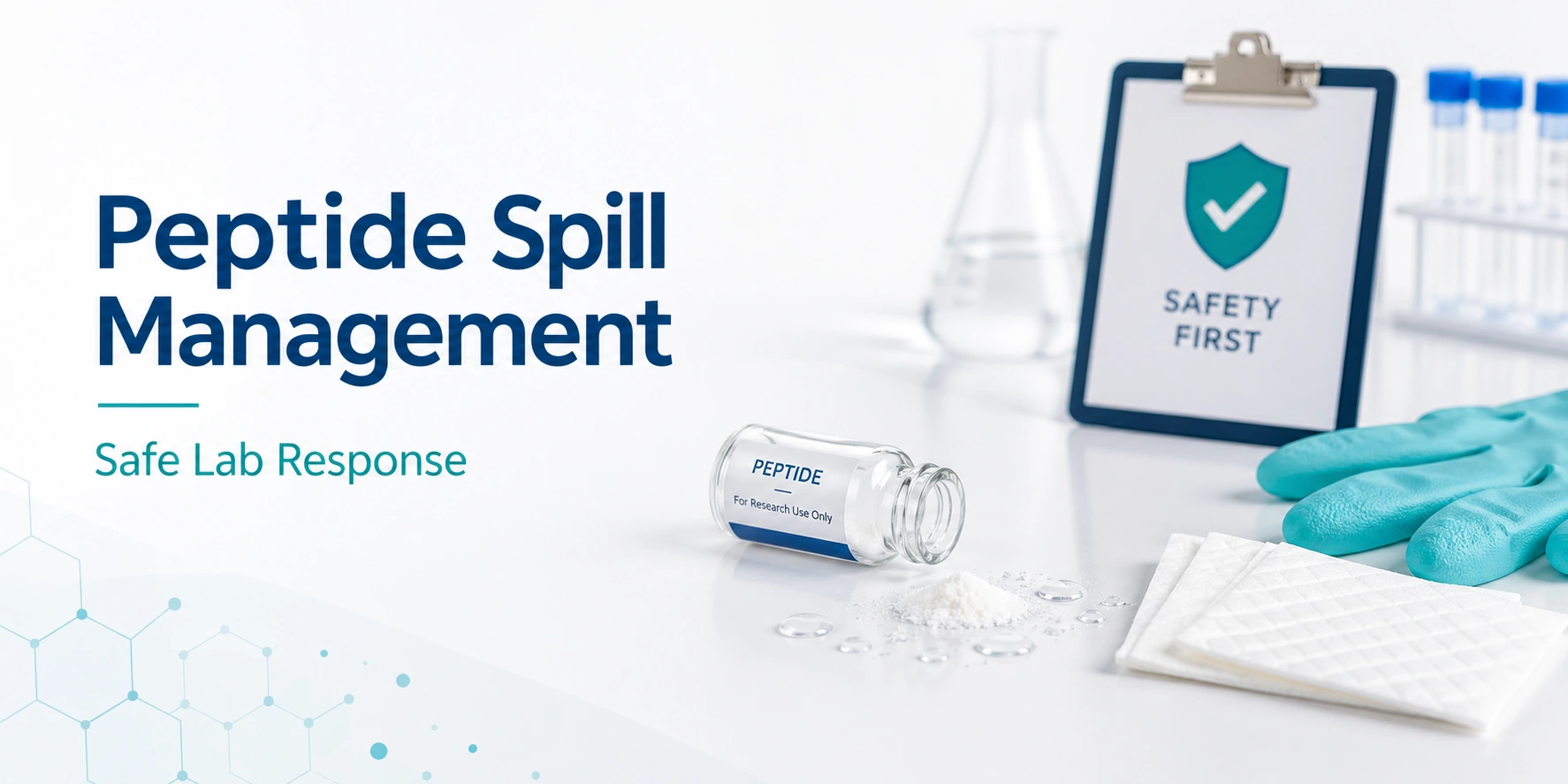
How to Clean a Dry Research Peptide Powder Spill
Dry peptide powder can become airborne when brushed, swept, blown, or disturbed. This may create an inhalation risk and spread contamination far beyond the original area.
Use the following general procedure only when the spill has been classified as minor and the laboratory procedure permits staff cleanup:
- Restrict access to the area.
- Turn off nearby equipment that may move air if the local procedure says this can be done safely.
- Review the peptide Safety Data Sheet and spill procedure.
- Put on the required personal protective equipment.
- Remove visible broken glass with forceps or tongs. Never pick it up by hand.
- Place compatible damp absorbent material gently over the powder when the Safety Data Sheet confirms that the chosen liquid is safe.
- Allow the material to become wet without spraying it.
- Collect the damp material carefully using a disposable scoop or absorbent pad.
- Work from the outer edge toward the centre to reduce spreading.
- Place all collected material in a compatible, labelled waste container.
- Clean the surface again using the approved decontamination method.
- Inspect nearby surfaces for fine residue or splash marks.
- Remove personal protective equipment carefully and wash your hands.
Do not dry sweep peptide powder. Do not use compressed air. Do not use a normal household or laboratory vacuum. A vacuum may spread fine particles through its exhaust unless it is specifically designed, approved, and maintained for that hazard.
Do not spray cleaning liquid directly onto dry powder. The force of the spray can push particles into the air. Apply the cleaning liquid gently to an absorbent pad instead.
How to Clean a Liquid Research Peptide Spill
A liquid spill can spread quickly through bench joints, equipment gaps, floor cracks, and drains. The carrier solvent may also produce vapour, create a fire risk, or damage the surface.
For a minor liquid spill that trained laboratory staff are permitted to manage:
- Restrict access and remove ignition sources when the formulation is flammable and this can be done safely.
- Check the peptide and solvent Safety Data Sheets.
- Put on the required personal protective equipment.
- Protect nearby drains without stepping into the contaminated area.
- Place compatible absorbent around the outer edge of the spill.
- Move inward slowly until the liquid is contained.
- Collect the absorbent with disposable tools.
- Place all material in a labelled waste container.
- Clean the affected surface with the approved cleaning solution.
- Repeat the cleaning process when the procedure requires it.
- Allow the surface to dry and inspect it under good lighting.
- Remove protective equipment carefully and wash your hands.
The carrier solvent controls many cleanup choices. A water based peptide solution may allow one method, while a solution containing a flammable or corrosive solvent may require ventilation, special gloves, and a different absorbent. Never select a cleanup method by considering the peptide alone.
Managing Peptide Spills Inside Laboratory Equipment
Biological Safety Cabinet
Keep the cabinet running unless the approved procedure gives a different instruction. Prevent liquid from entering the front or rear grilles when possible. If material enters the drain pan, filter area, blower system, or another hidden section, stop and contact the cabinet manager or biosafety team.
When infectious biological material is also present, follow the biological spill procedure and use a disinfectant with a suitable contact time. A disinfectant that controls microorganisms may not remove or deactivate the peptide itself. Both hazards must be addressed.
Chemical Fume Hood
Keep the hood operating when vapour control is needed and it is safe to do so. Lower the sash and notify others. Do not place your head inside the hood. If the spill enters service channels, electrical equipment, or hidden spaces, request specialist support.
Centrifuge
Stop the centrifuge and keep the lid closed when tube failure may have created an aerosol. Follow the equipment and laboratory procedure before opening it. A centrifuge spill may require a waiting period, sealed bucket removal, and cleaning inside approved containment.
Freezer or Cold Room
Restrict access and assess ventilation. Cold conditions may slow evaporation, but they do not remove the chemical or biological hazard. Organic vapours may collect in a poorly ventilated space. Contact Environmental Health and Safety when the solvent hazard is uncertain.
Selecting a Decontamination Method
There is no universal liquid that safely deactivates every research peptide. Water, detergent, alcohol, bleach, and other cleaning agents have different effects. Some may spread the substance, damage the surface, react with the solvent, or create harmful vapour.
Select the cleaning method using:
- The peptide Safety Data Sheet
- The solvent Safety Data Sheet
- The laboratory standard operating procedure
- Information from the manufacturer
- Surface compatibility
- Waste disposal requirements
- Advice from Environmental Health and Safety
A compatible laboratory detergent and water may remove some peptide residues from a nonporous surface, but this should not be assumed for every compound. Highly potent peptides may require a validated cleaning method. The laboratory may also need surface sampling when a small amount of residue could affect worker safety, future experiments, or product quality.
Bleach is commonly used against many biological contaminants. It should not be treated as a universal peptide neutraliser. It can react with other chemicals and damage metals or equipment. Use it only when the procedure confirms that it is appropriate for every material in the spill.
Personal Protective Equipment for Peptide Spill Cleanup
Personal protective equipment should be chosen through a hazard assessment. Basic laboratory clothing alone may not provide enough protection for a cleanup task.
Depending on the risk, required equipment may include:
- A fully fastened laboratory coat or disposable gown
- Chemical splash goggles
- A face shield when splash risk is high
- Gloves selected for the peptide and carrier solvent
- Double gloves for potent compounds when required by the procedure
- Protective sleeves
- Closed shoes and full length clothing
- Disposable shoe covers when floor contamination is possible
Glove material must match the formulation. A glove that protects against an aqueous buffer may provide poor protection against an organic solvent. Check the glove manufacturer compatibility information and the Safety Data Sheet.
A respirator should never be used as an improvised answer to an unknown spill. Respirator use requires proper selection, medical clearance, training, fit testing, and an established respiratory protection programme. If airborne exposure may require respiratory protection, untrained staff should leave the area and call the emergency response team.
What to Do After Personal Exposure
Eye Exposure
Begin flushing the eyes immediately at an eyewash station. Hold the eyelids open and rinse continuously for at least 15 minutes unless the Safety Data Sheet or emergency team gives a different instruction. Remove contact lenses when practical, but do not delay irrigation to remove them. Seek medical evaluation and provide the product information.
Skin Exposure
Remove contaminated clothing and rinse the affected skin with running water. Use the safety shower for a large exposure. Continue rinsing for at least 15 minutes unless the Safety Data Sheet states otherwise. Do not use solvents to clean the skin. Obtain medical advice, especially when the peptide is biologically active or poorly studied.
Inhalation
Move the affected person to fresh air without entering a contaminated area without protection. Call emergency or occupational health services. Do not allow the person to return to work simply because symptoms are not immediate.
Ingestion or Needlestick Exposure
Seek urgent medical advice. Do not induce vomiting unless a medical professional or the Safety Data Sheet specifically instructs it. For a needlestick, wash the area, report the incident immediately, and follow the laboratory exposure protocol.
Bring the peptide label, concentration, formulation, Safety Data Sheet, and estimated amount of exposure to the medical team. These details can be more useful than the product name alone.
Managing Waste From Peptide Spill Cleanup
Used absorbent, disposable tools, contaminated gloves, broken containers, and cleaning materials may need to be managed as hazardous chemical waste, biological waste, sharps waste, or mixed waste.
Place waste in a container that is compatible with the peptide and solvent. Close the container when waste is not being added. Label it with the contents and hazards according to local rules. Never mix cleanup waste with another waste stream unless the laboratory waste procedure permits it.
Broken glass should be handled with forceps, tongs, or a scoop. Contaminated needles and other sharp objects belong in an approved sharps container. Do not push sharp material into a soft waste bag.
Do not pour peptide solution, cleaning liquid, or absorbed residue into a sink simply because the original volume was small. Drain disposal depends on the chemical, biological activity, concentration, local permit, and waste rules. Ask the laboratory waste coordinator when the disposal route is uncertain.
Report and Review the Incident
A spill report should describe more than the fact that the bench was cleaned. Record:
- The date and time
- The exact location
- The peptide identity
- The concentration and formulation
- The estimated amount released
- The cause of the spill
- Any personal exposure
- The immediate response
- The protective equipment used
- The cleaning materials used
- The waste container and disposal route
- The people notified
- Any equipment affected
- Corrective action
Review the cause after the area is safe. Was the tube overfilled? Did the cap fail? Was the vial carried without secondary containment? Was the worker using unsuitable gloves? Did the spill kit lack the correct material?
The aim is not to blame a person. The aim is to remove the weak point that allowed the incident to happen.
How to Prevent Research Peptide Spills
Prevention is usually simpler and safer than cleanup. The following controls can reduce spill frequency and severity:
- Handle the smallest practical quantity.
- Open dry peptide containers inside suitable containment.
- Allow frozen vials to reach the approved temperature before opening.
- Use screw cap tubes that match the solvent.
- Inspect vials and caps for damage.
- Keep containers away from bench edges.
- Use tube racks with a stable base.
- Transport vials in closed secondary containment.
- Use a tray during dilution and transfer.
- Avoid rapid pipetting that creates droplets or bubbles.
- Balance centrifuge tubes correctly.
- Use sealed centrifuge buckets when required.
- Train workers before they handle a new peptide.
- Review the risk assessment when the concentration or scale changes.
- Check spill kits regularly and replace expired items.
A spill plan should be tested through practical drills. Reading a procedure is useful, but a drill reveals whether staff can find the eyewash, emergency number, Safety Data Sheet, warning signs, and correct waste container under pressure.
Common Peptide Spill Management Mistakes
Assuming Every Peptide Is Harmless
Peptides are often viewed as simple biological molecules. This assumption ignores potency, formulation, chemical modification, and incomplete toxicology data.
Cleaning Before Assessing the Hazard
Fast action is not always safe action. A thirty second assessment can prevent inhalation, skin exposure, or an incompatible chemical reaction.
Dry Sweeping Powder
Sweeping can move fine powder into the air and spread it across a larger area.
Using Bleach for Every Spill
Bleach may be unsuitable for the peptide, solvent, surface, or nearby chemicals. It should be used only when supported by the approved procedure.
Using the Wrong Gloves
Glove selection must consider the carrier solvent. A familiar glove is not automatically the correct glove.
Using an Ordinary Vacuum
An unsuitable vacuum can spread contamination through its exhaust and contaminate the internal filter or motor.
Discarding Waste in the General Bin
Cleanup materials may retain active peptide and hazardous solvent. They must follow the correct laboratory waste route.
Failing to Report a Small Spill
A minor spill can reveal a larger system problem. Reporting allows the laboratory to correct storage, equipment, training, and handling weaknesses.
Research Peptide Spill Response Checklist
| Stage | Required action |
|---|---|
| Alert | Warn nearby staff and restrict access. |
| Exposure | Move exposed people to the eyewash, safety shower, or fresh air. |
| Identify | Confirm the peptide, concentration, solvent, and amount. |
| Assess | Decide whether trained staff may manage the spill. |
| Escalate | Call Environmental Health and Safety when the hazard is unknown or beyond local capability. |
| Protect | Use personal protective equipment selected for the complete formulation. |
| Contain | Prevent powder, liquid, and contaminated footwear from spreading. |
| Collect | Use compatible absorbent and disposable tools. |
| Clean | Apply the approved surface decontamination method. |
| Dispose | Label and manage all cleanup materials through the correct waste stream. |
| Report | Document the incident, exposure, response, and corrective action. |
| Restore | Replace used spill supplies before normal work resumes. |
Conclusion
Effective spill management procedures for research peptides depend on careful judgement rather than one universal cleanup recipe. Start by protecting people, identifying the full formulation, reviewing the Safety Data Sheet, and deciding whether laboratory staff can manage the event safely. Control dry powder without creating dust, contain liquid from the outside toward the centre, use protective equipment that matches the peptide and solvent, and place every contaminated item in the correct waste stream. When the identity, potency, exposure, or cleanup method is uncertain, restrict the area and call trained safety professionals. A thoughtful response protects staff, research quality, equipment, and the wider environment.
Frequently Asked Questions
What should I do first after a research peptide spill?
Alert nearby staff, keep people away from the area, and check whether anyone has been exposed. Confirm the peptide identity, concentration, carrier solvent, amount released, and spill location before starting cleanup.
Are all research peptides hazardous?
No. Research peptides have different properties and levels of biological activity. However, limited hazard data do not prove that a peptide is safe. Unknown or poorly studied peptides should be treated as potentially hazardous.
How should dry peptide powder be cleaned?
Do not sweep, brush, blow, or spray the powder. When the approved procedure allows local cleanup, gently cover it with compatible damp absorbent material, collect it from the outer edge toward the centre, and place it in a labelled waste container.
Can bleach deactivate a spilled research peptide?
Bleach is not a universal peptide decontamination agent. It may react with solvents, damage surfaces, or fail to remove the peptide. Use it only when the laboratory procedure confirms that it is suitable for every material in the spill.
Can research peptide solution be poured down a drain?
Do not use drain disposal unless it is specifically approved. The correct route depends on the peptide, concentration, biological activity, solvent, local discharge permit, and applicable waste rules.
What protective equipment is needed for peptide spill cleanup?
The required equipment depends on the hazard assessment. It may include a laboratory coat or gown, splash goggles, compatible gloves, protective sleeves, a face shield, and shoe covers. Respirators require a formal protection programme.
When should Environmental Health and Safety manage the spill?
Request specialist help when the peptide is unknown, highly potent, poorly studied, airborne, mixed with a dangerous solvent, released in a large amount, located in a public area, or associated with personal exposure.
How should a peptide spill inside a biological safety cabinet be handled?
Keep the cabinet operating unless the approved procedure says otherwise. Prevent material from entering the grilles. Follow both the peptide cleanup procedure and the biological spill procedure when infectious material is present.
References
- Occupational Safety and Health Administration.
Hazard Communication Standard: Safety Data Sheets
. - Occupational Safety and Health Administration.
Appendix D: Safety Data Sheets
. - Occupational Safety and Health Administration.
National Research Council Recommendations Concerning Chemical Hygiene in Laboratories
. - National Institutes of Health Office of Research Services.
Chemical Safety Guide
. - National Institutes of Health Office of Research Services.
Spill in Laboratory
. - National Research Council.
Prudent Practices in the Laboratory: Working With Chemicals
. - Centers for Disease Control and Prevention and National Institutes of Health.
Biosafety in Microbiological and Biomedical Laboratories
. - United States Environmental Protection Agency.
Managing Your Hazardous Waste
. - Stony Brook University Environmental Health and Safety.
Chemical Spills
.
Regulatory requirements differ by country and institution. United States sources are used as recognised laboratory safety references. Laboratories in other locations should follow their national law, local waste rules, and institutional safety procedures.