
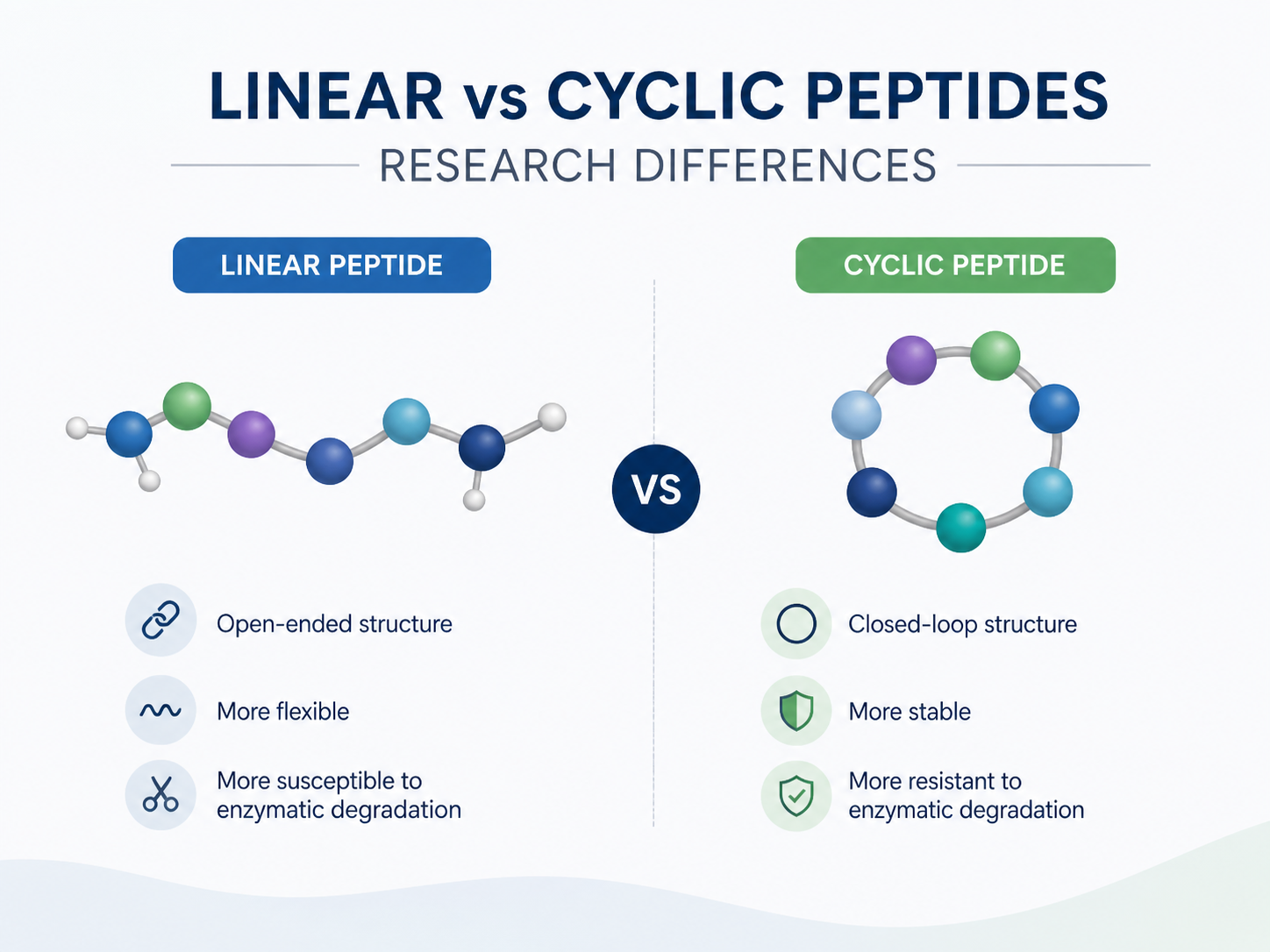

Linear peptides are open-chain amino acid sequences with free N- and C-termini, while cyclic peptides contain a covalent bond that links parts of the sequence into a ring structure. This structural difference significantly influences flexibility, stability, protease resistance, binding thermodynamics, and membrane permeability.
Linear peptides are generally easier to synthesize and modify, making them well suited for motif mapping, enzyme assays, and exploratory research. Cyclic peptides, due to their conformational constraint, often demonstrate improved proteolytic stability, reduced entropy penalties upon binding, and enhanced resistance to degradation.
The choice between linear and cyclic peptides depends on the research objective. For mechanistic studies requiring sequence flexibility, linear peptides are often sufficient. For applications requiring structural stability, prolonged half-life, or improved target affinity, cyclic peptides may offer measurable advantages.
Why This Distinction Matters in Research
At first glance, linear and cyclic peptides differ only in topology. One is open-ended; the other forms a ring. In practice, this structural difference alters fundamental biochemical behavior.
In laboratory research, peptide topology affects nearly every experimental variable:
- Conformational flexibility
- Binding thermodynamics
- Enzymatic degradation
- Structural predictability
- Cellular stability
Understanding these differences is essential for selecting the correct molecular tool.
Structural Topology and Conformational Space
Linear peptides possess free terminal ends and a flexible backbone. This flexibility allows them to sample many conformations in solution. While this dynamic behavior can be useful in certain assays, it also introduces entropy costs during binding. When a linear peptide interacts with a target protein, it must adopt a more ordered conformation, which reduces entropy and can weaken binding affinity.
Cyclic peptides, by contrast, are conformationally constrained. Cyclization reduces the number of accessible conformations in solution. Because the structure is partially pre-organized, the entropy penalty during binding is often lower. This can enhance effective binding affinity, particularly when targeting extended protein surfaces such as protein–protein interaction interfaces.
Protease Sensitivity and Stability
Free N- and C-termini in linear peptides are susceptible to exopeptidase activity. In biological systems and enzymatic assays, this can result in rapid degradation. Cyclic peptides eliminate free termini, which inherently reduces susceptibility to certain proteases. Additionally, the constrained backbone may hinder enzymatic access to cleavage sites.
For research studies involving cellular systems, in vitro stability testing, or prolonged incubation, these stability differences can significantly affect experimental outcomes.
Impact on Research Design
The distinction between linear and cyclic peptides is not merely academic. It directly influences:
- Experimental half-life
- Reproducibility
- Required concentration
- Buffer compatibility
- Downstream analytical interpretation
For example, in receptor-binding assays that require extended incubation times, a cyclic peptide may retain activity longer than its linear counterpart. Conversely, in short-term mechanistic studies, the synthetic simplicity of linear peptides may be preferable.
As peptide research expands into drug discovery, molecular targeting, and intracellular modulation, understanding the structural consequences of cyclization has become increasingly important.
Choosing between linear and cyclic formats is therefore a strategic decision, grounded in thermodynamics, structural chemistry, and experimental constraints.
Structural Differences
The fundamental difference between linear and cyclic peptides lies in molecular topology. While both are composed of amino acid sequences connected by peptide bonds, the way those sequences are arranged in space defines their behavior.
Linear Peptide Architecture
Linear peptides consist of an open-chain backbone with a free amino terminus (N-terminus) and a free carboxyl terminus (C-terminus). This open topology allows significant rotational freedom around backbone bonds.
As a result, linear peptides:
- Sample multiple conformations in solution
- Exhibit high structural flexibility
- Often exist as dynamic ensembles rather than defined shapes
This conformational variability can be advantageous in exploratory research, particularly when studying sequence-dependent interactions. However, flexibility also means that linear peptides may not adopt a stable secondary structure unless stabilized by external interactions, such as binding to a protein target.
In many cases, linear peptides remain largely disordered in solution. Upon binding to a receptor or enzyme, they transition into a more ordered conformation. This disorder-to-order transition carries an entropic cost, which can influence binding strength.
Cyclic Peptide Architecture
Cyclic peptides are characterized by a covalent bond that connects parts of the sequence into a closed ring. This bond may form between:
- The N-terminus and C-terminus (head-to-tail cyclization)
- A terminal residue and a side chain
- Two side chains within the sequence
By forming a ring, cyclic peptides eliminate free termini and restrict backbone rotation.
This structural constraint produces several important consequences:
First, conformational freedom is reduced. The peptide is pre-organized into a limited set of shapes. Second, intramolecular hydrogen bonding may become more stable. Third, certain side chains may be positioned in orientations that favor binding interactions.
In structural terms, cyclic peptides often occupy a more defined conformational space than linear peptides. This increased rigidity can improve target engagement when the cyclic conformation resembles the bound state of the peptide.
Importantly, not all cyclic peptides are equally rigid. Ring size, sequence composition, and cyclization chemistry influence overall structural behavior. Smaller macrocycles tend to impose stronger conformational restriction, while larger cycles may retain partial flexibility.
Stability and Protease Resistance
Structural differences directly influence biochemical stability.
One of the major limitations of linear peptides in research is susceptibility to enzymatic degradation. Exopeptidases recognize and cleave amino acids from free termini. Because linear peptides possess both N- and C-terminal ends, they are inherently vulnerable to such enzymatic attack.
Additionally, their flexible backbone allows proteases easier access to internal cleavage sites.
Degradation Pathways in Linear Peptides
Linear peptides may undergo:
- N-terminal trimming by aminopeptidases
- C-terminal trimming by carboxypeptidases
- Endopeptidase cleavage at internal residues
In in vitro systems containing serum, cellular extracts, or proteolytic enzymes, degradation can occur rapidly. This may reduce effective concentration and compromise reproducibility if not properly controlled.
Short incubation experiments may not reveal these effects, but longer assays often demonstrate measurable degradation.
Enhanced Stability in Cyclic Peptides
Cyclization fundamentally alters proteolytic susceptibility.
Because cyclic peptides lack free termini, exopeptidases cannot initiate terminal cleavage. Furthermore, the constrained backbone may limit protease access to internal cleavage sites.
Backbone rigidity can reduce the ability of enzymes to bind and align catalytic residues for hydrolysis. In many experimental comparisons, cyclic peptides show increased resistance to enzymatic degradation relative to their linear analogs.
This increased stability translates into:
- Longer half-life in biological media
- Greater persistence in cell-based assays
- Reduced need for high dosing in in vitro systems
However, stability depends on sequence composition as well. Cyclization alone does not guarantee resistance to all proteases. Certain sequences may still contain vulnerable cleavage sites.
Experimental Implications
For research involving:
- Extended incubation times
- Protease-rich environments
- Serum-containing media
- In vivo models
cyclic peptides often provide improved stability profiles.
Conversely, in tightly controlled biochemical assays where degradation is minimal, linear peptides may perform adequately and offer easier synthesis and modification.
Thus, the stability advantage of cyclic peptides is context-dependent but frequently significant in biological systems.
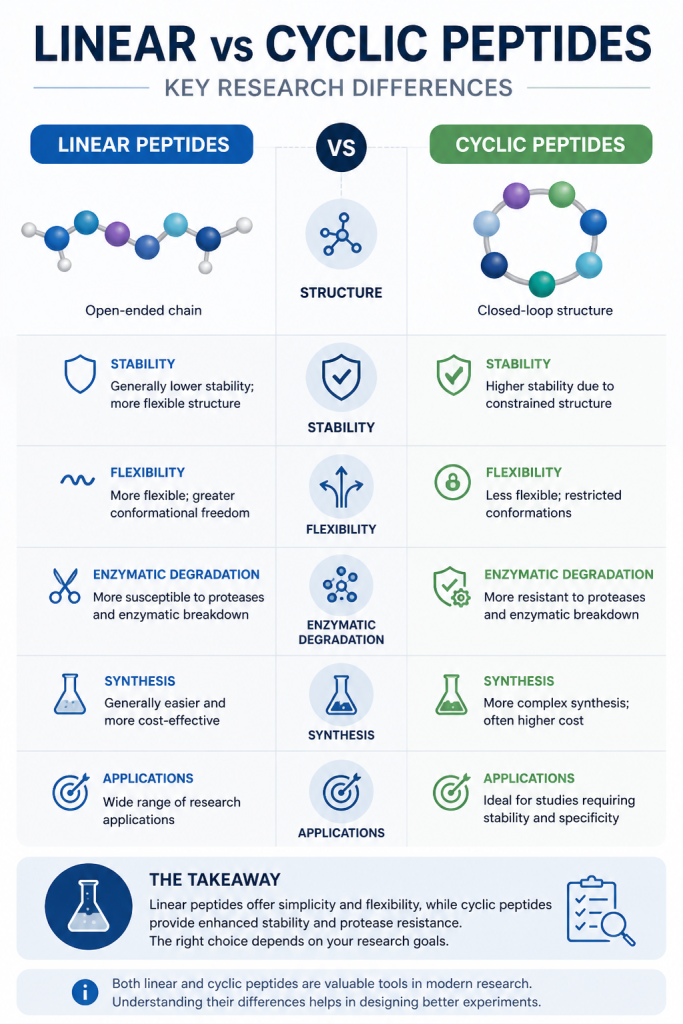
Binding Affinity and Thermodynamics
One of the most important research differences between linear and cyclic peptides emerges in binding thermodynamics.
Binding affinity is governed by enthalpic and entropic contributions. While both linear and cyclic peptides can form strong intermolecular contacts with their targets, their conformational behavior prior to binding significantly influences overall affinity.
Entropy and Conformational Flexibility
Linear peptides typically exist as flexible, dynamic ensembles in solution. When a linear peptide binds to a receptor or protein surface, it must adopt a specific conformation that complements the binding site. This transition from a flexible state to a more ordered bound state reduces conformational entropy.
That entropy loss imposes a thermodynamic penalty. Even if enthalpic interactions such as hydrogen bonding or hydrophobic contacts are strong, the entropy cost can weaken overall binding affinity.
Cyclic peptides behave differently.
Because their backbone is conformationally constrained, cyclic peptides often exist in a more pre-organized state. If the cyclic structure resembles the bound conformation, the entropy penalty during binding is reduced. As a result, effective affinity may increase.
This principle is particularly relevant in protein–protein interaction studies, where large, shallow binding interfaces are difficult to target with small molecules. Cyclic peptides can better mimic extended interaction surfaces and present key residues in a defined spatial orientation.
Conformational Pre-Organization
Pre-organization does not guarantee stronger binding in every case. If the constrained conformation does not match the binding geometry required by the target, affinity may decrease. However, when designed correctly, cyclic peptides often show improved binding efficiency relative to linear analogs of identical sequence.
In research practice, this means:
- Cyclic peptides are often favored when targeting structured interfaces.
- Linear peptides are useful when flexibility is required for induced fit interactions.
Understanding the thermodynamic balance between entropy and enthalpy is central to selecting the appropriate topology.
Membrane Permeability and Bioavailability
Another major research distinction involves permeability and systemic stability.
Peptides are generally polar molecules with multiple hydrogen bond donors and acceptors. This intrinsic polarity limits passive membrane diffusion, particularly for linear peptides.
Linear Peptides and Permeability
Linear peptides expose polar backbone amide bonds and terminal charges. In aqueous environments, these features promote solubility but reduce membrane permeability. Additionally, free termini increase recognition by transporters and degradative enzymes.
As a result, many linear peptides exhibit:
- Limited cellular uptake
- Rapid clearance in biological systems
- Low oral bioavailability
In laboratory settings, this may require higher concentrations or specialized delivery systems when working with cell-based assays.
Cyclic Peptides and Polarity Masking
Cyclization can alter permeability characteristics in several ways.
First, elimination of free termini reduces overall polarity. Second, cyclic peptides can form intramolecular hydrogen bonds that shield polar backbone groups from solvent exposure. This “polarity masking” reduces the apparent polar surface area.
In some cyclic peptides, these features improve passive diffusion across membranes. While not all cyclic peptides are cell-permeable, macrocyclic structures have demonstrated improved pharmacokinetic profiles compared to comparable linear sequences.
This difference is especially relevant in:
- Intracellular target studies
- Protein–protein interaction inhibition
- Translational research contexts
However, permeability remains sequence-dependent. Ring size, hydrophobic content, and backbone rigidity all influence transport properties.
Research Context Considerations
In purely in vitro biochemical assays, permeability may not matter. In cell-based experiments or in vivo models, it becomes a critical parameter.
Therefore:
- For extracellular receptor studies, linear peptides may be sufficient.
- For intracellular modulation or stability-sensitive applications, cyclic peptides may offer practical advantages.
Topology influences not only chemical behavior but also experimental design strategy.
Synthesis Considerations and Practical Laboratory Differences
Beyond structural and thermodynamic differences, linear and cyclic peptides also differ significantly in synthetic complexity, yield, scalability, and cost. These factors influence laboratory decision-making as much as biological performance.
Linear Peptides: Simplicity and Efficiency
Linear peptides are generally straightforward to synthesize using standard solid-phase peptide synthesis (SPPS).
The process involves sequential coupling of protected amino acids on a solid resin, followed by final cleavage and purification. Because no intramolecular bond formation is required during assembly, synthesis cycles remain relatively predictable.
Key practical advantages of linear peptides include:
- High coupling efficiency for short to medium sequences
- Lower risk of cyclization failure
- Simpler purification profiles
- Faster production timelines
- Lower synthetic cost
For motif mapping, enzyme substrate screening, or early-stage exploratory studies, linear peptides are often preferred due to their rapid and reproducible synthesis.
In most research laboratories, short linear peptides can be synthesized and purified with high overall yield and minimal optimization.
Cyclic Peptides: Additional Complexity
Cyclic peptide synthesis introduces an extra synthetic challenge: intramolecular ring closure.
Cyclization can occur through:
- Head-to-tail backbone linkage
- Side chain-to-side chain bond formation
- Side chain-to-terminal linkage
This ring-forming step requires careful control of reaction conditions.
The main synthetic challenges include:
- Competing intermolecular reactions (leading to dimers or oligomers)
- Incomplete cyclization
- Sequence-dependent steric hindrance
- Reduced yield due to inefficient ring closure
To favor intramolecular cyclization over intermolecular reactions, synthesis is often performed under dilute conditions. However, dilution reduces overall reaction rate and may decrease yield.
Ring size plays a significant role in success. Very small rings can introduce strain, while very large rings may not cyclize efficiently due to conformational flexibility.
Because of these constraints, cyclic peptide synthesis may require additional optimization compared to linear analogs.
Yield and Scalability Differences
In linear peptide synthesis, each coupling step introduces incremental yield loss. As sequence length increases, cumulative inefficiencies reduce final yield. However, for typical laboratory peptides under 30 residues, yields are generally acceptable.
For cyclic peptides, yield is influenced by two major factors:
- Efficiency of linear precursor synthesis
- Efficiency of the cyclization reaction
Even when the linear precursor is produced successfully, cyclization may reduce overall yield significantly if reaction conditions are not optimized.
Thus, cyclic peptides may be more resource-intensive in both time and material cost.
Modification and Functionalization
Linear peptides are often easier to modify because their termini are accessible. N-terminal labeling, C-terminal tagging, and conjugation to probes are straightforward.
Cyclic peptides lack free termini, which may complicate labeling strategies unless specific reactive side chains are incorporated intentionally.
This affects:
- Fluorescent labeling
- Surface immobilization
- Conjugation to carriers
- Analytical tagging
In research applications requiring flexible modification, linear peptides may offer practical advantages.
Choosing Based on Experimental Context
From a laboratory perspective, the decision between linear and cyclic peptides is often driven by practical constraints as much as theoretical performance.
Linear peptides are typically chosen when:
- Rapid synthesis is required
- Cost must be minimized
- Structural rigidity is not essential
- Short incubation times are used
Cyclic peptides are typically chosen when:
- Stability in biological media is critical
- Protease resistance is required
- Binding affinity needs optimization
- Target engagement involves structured protein interfaces
Understanding these synthetic and practical differences ensures better experimental planning and reproducibility.
| Parameter | Linear Peptides | Cyclic Peptides | Research Implication |
| Topology | Open-chain with free N- and C-termini | Closed-ring structure via covalent linkage | Topology defines flexibility and stability |
| Conformational Flexibility | High flexibility; multiple conformations in solution | Constrained; limited conformational space | Affects entropy during binding |
| Entropy Penalty Upon Binding | Higher entropy loss due to disorder-to-order transition | Reduced entropy penalty if pre-organized | Cyclic peptides may show improved affinity |
| Protease Sensitivity | Susceptible to exopeptidase and endopeptidase cleavage | Resistant to exopeptidase; often more resistant overall | Influences half-life in biological assays |
| Terminal Stability | Free termini vulnerable to enzymatic trimming | No free termini; reduced degradation pathways | Important in serum-containing experiments |
| Backbone Rigidity | Flexible backbone | Restricted rotation | Impacts structural predictability |
| Binding Specificity | Sequence-dependent; may require conformational adaptation | Often improved when conformation matches target | Relevant in protein–protein interaction studies |
| Membrane Permeability | Generally low due to exposed polarity | May improve via polarity masking and intramolecular H-bonds | Important in intracellular target research |
| Solubility | Often high in aqueous systems | Sequence-dependent; sometimes reduced | Affects formulation and assay preparation |
| Synthesis Complexity | Straightforward SPPS | Requires additional cyclization step | Impacts time and cost |
| Yield | Generally higher for short sequences | May decrease due to cyclization inefficiency | Influences scalability |
| Scalability | Easier to scale | More challenging for complex macrocycles | Relevant in translational research |
| Modification Flexibility | Easy N- or C-terminal labeling | Requires strategic placement of reactive groups | Impacts probe development |
| Cost of Production | Lower | Typically higher | Budget consideration in early research |
| Aggregation Risk During Synthesis | Moderate; sequence-dependent | May increase for certain constrained sequences | Requires optimization |
| Typical Use Cases | Motif mapping, enzyme substrates, epitope studies | PPI inhibition, receptor targeting, stability-sensitive assays | Context determines choice |
| Length Limitations | Efficiency decreases with length | Ring size constraints add complexity | Structural design must be considered |
| Thermodynamic Profile | Often entropically penalized upon binding | Potentially more entropically favorable | Influences affinity optimization |
| Biological Half-Life | Often shorter in protease-rich systems | Frequently extended | Important in cell-based and in vivo studies |
Research Applications: When to Choose Linear vs Cyclic Peptides
The decision between linear and cyclic peptides should always be driven by experimental goals rather than structural preference.
When Linear Peptides Are Preferred
Linear peptides are often selected in early-stage and mechanistic research where speed, flexibility, and cost efficiency matter.
They are commonly used for:
- Epitope mapping
- Enzyme substrate screening
- Motif identification studies
- Phosphorylation site analysis
- Preliminary binding investigations
In these applications, conformational rigidity is not always required. The goal is often to determine whether a sequence region plays a functional role. Linear peptides are faster to synthesize, easier to modify, and more adaptable for high-throughput screening.
For short incubation biochemical assays, their susceptibility to degradation may not significantly affect outcomes.
When Cyclic Peptides Are Preferred
Cyclic peptides are typically chosen when stability, structural precision, or enhanced binding performance is required.
They are especially valuable in:
- Protein–protein interaction inhibition
- Receptor targeting studies
- Stability-sensitive cell-based assays
- Long-duration incubation experiments
- Translational and preclinical research
When targeting structured protein interfaces, cyclic peptides can present key residues in defined spatial orientation, improving interaction strength. Their enhanced resistance to proteolytic degradation makes them better suited for experiments conducted in serum-containing media or biological environments.
In cases where intracellular activity is needed, cyclic topology may improve persistence and functional duration.
Limitations of Each Class
Neither linear nor cyclic peptides are universally optimal. Each has inherent limitations that must be considered.
Limitations of Linear Peptides
Linear peptides may suffer from:
- Rapid enzymatic degradation
- Reduced half-life in biological systems
- Entropic penalties during binding
- Limited membrane permeability
These factors can reduce effective concentration and introduce variability in cell-based experiments.
Limitations of Cyclic Peptides
Cyclic peptides introduce different challenges:
- More complex synthesis and lower yield
- Higher production cost
- Potential solubility issues depending on ring size
- Structural rigidity that may reduce binding if misaligned
Additionally, not all cyclization strategies improve performance. Poorly designed macrocycles may constrain the peptide in an unfavorable conformation.
Thus, cyclization must be purposeful and structurally justified.
Conclusion
Linear and cyclic peptides differ fundamentally in topology, flexibility, stability, and experimental behavior.
Linear peptides are open-chain molecules with high conformational freedom. They are easier to synthesize, rapidly modifiable, and well suited for exploratory or mechanistic studies.
Cyclic peptides contain a covalent ring structure that restricts conformational space. This constraint often enhances protease resistance, reduces entropy loss upon binding, and improves stability in biological systems.
From a research perspective:
- Choose linear peptides when simplicity, speed, and flexibility are priorities.
- Choose cyclic peptides when stability, structural precision, or enhanced target engagement is required.
The correct decision depends on the biological context, assay design, and experimental duration.
Understanding these research differences improves reproducibility, data interpretation, and experimental efficiency.
FAQs
1. Are cyclic peptides always more stable than linear peptides?
Cyclic peptides are generally more resistant to exopeptidase degradation due to the absence of free termini, but stability ultimately depends on sequence composition and environmental conditions.
2. Do cyclic peptides always bind more strongly than linear peptides?
Not necessarily. Cyclization reduces entropy penalties and may enhance binding if the constrained conformation matches the target. Poorly aligned constraints can reduce affinity.
3. Which type is easier to synthesize in the laboratory?
Linear peptides are typically easier and faster to synthesize. Cyclic peptides require an additional cyclization step, which can reduce yield and increase complexity.
4. Are cyclic peptides more permeable across membranes?
Some cyclic peptides exhibit improved membrane permeability due to polarity masking and intramolecular hydrogen bonding, but permeability is highly sequence-dependent.
5. Can a linear peptide be converted into a cyclic version?
Yes. Many research strategies involve synthesizing a linear precursor followed by intramolecular cyclization to evaluate performance differences.
References
BiochemPEG. (2023). Cyclic peptides: Classification and applications. https://www.biochempeg.com/article/369.html
Creative Peptides. (n.d.). Cyclic vs linear peptides: What’s the difference? https://www.creative-peptides.com/resources/cyclic-vs-linear-peptides-what-s-the-difference.html
Gong, W., et al. (2025). Computational design of linear and cyclic peptide binders (EvoBind2). Communications Chemistry. https://www.nature.com/articles/s42004-025-01601-3
Pharmaceuticals. (2023). Cyclic peptides in pipeline: What future for these great molecules? https://www.researchgate.net/figure/Comparison-between-approved-cyclic-and-linear-peptides-A-Routes-of-administration-of_fig2_372354208



[…] peptides are linear polymers constructed from amino acids linked together by amide bonds, universally termed peptide bonds. Each monomeric amino acid contains a central alpha-carbon bonded to four distinct species: an amino group, a carboxyl group, a hydrogen atom, and a variable side chain (R-group). […]