
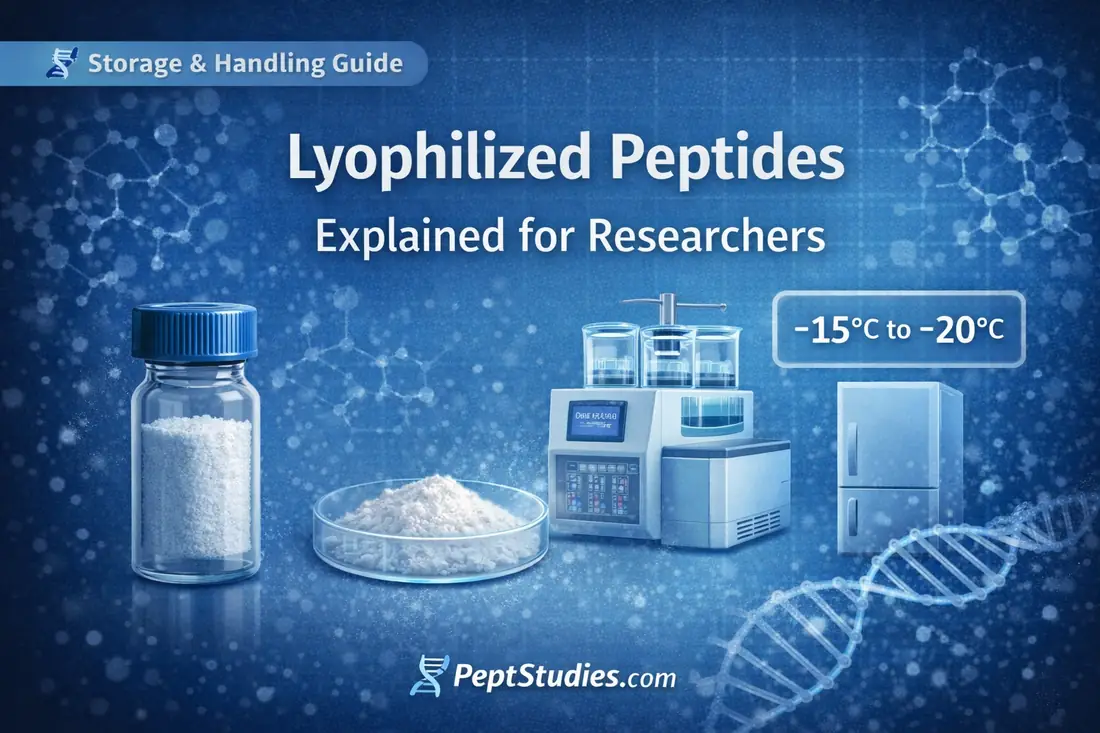

Lyophilized peptides have become essential tools in laboratories across the world. If you work in biochemistry, molecular biology, or pharmaceutical research, you’ve probably seen a small vial of powder labeled as a lyophilized peptide. But what exactly is lyophilization, and why is it used for peptides?
How do you reconstitute, store, and handle these delicate molecules to get consistent results? Most importantly, what are the practical tips and common mistakes that can make or break your experiments?
This article is designed for researchers at all levels who want to understand lyophilized peptides from the ground up. We’ll break down the science in clear language, give you practical advice, and answer the technical questions that often remain unclear.
By the end, you’ll feel confident handling, storing, and using lyophilized peptides in your own research.
What Are Lyophilized Peptides?
A lyophilized peptide is a synthetic or natural peptide that has been dried using a special process called lyophilization, or freeze-drying. In this process, water is removed from the peptide solution under low temperature and vacuum. This leaves a stable, dry powder that can be stored for long periods.
Lyophilization is used because peptides in solution can break down quickly, losing their structure and function. By removing water, lyophilized peptides remain stable, pure, and easy to ship or store.
Peptides are short chains of amino acids joined by peptide bonds. They are smaller than proteins and serve as building blocks for many biological processes. Some famous examples are insulin (a hormone), oxytocin (a neurotransmitter), and many signaling molecules used in research.
The Lyophilization Process
Understanding how lyophilization works is key to handling peptides correctly. The process involves three main steps:
- Freezing: The peptide solution is cooled to very low temperatures, usually between -40°C to -80°C. This turns the water into ice.
- Primary Drying (Sublimation): The ice is removed by reducing the pressure. Ice changes directly from solid to vapor (sublimation), leaving behind a dry matrix of peptide.
- Secondary Drying (Desorption): Any water left is removed by gently increasing the temperature under vacuum. This ensures the peptide is as dry as possible.
The result is a white or off-white powder that contains the intact peptide molecule. The process preserves the peptide’s structure, purity, and bioactivity.
Why Lyophilize Peptides?
- Stability: Lyophilized peptides can last for years at room temperature, while peptides in solution may degrade in days or weeks.
- Transport: Dry peptides are less sensitive to temperature changes during shipping.
- Purity: The process can help remove some impurities, but most purity comes from careful synthesis.

Credit: limitlessbiochem.eu
Advantages Of Lyophilized Peptides
Using lyophilized peptides in research brings several significant advantages:
- Extended shelf life: Peptides remain stable and active for years when stored properly.
- Reduced risk of contamination: No water means less chance for bacteria or fungi to grow.
- Accurate dosing: Dry powder allows precise measurement for experiments.
- Easier shipping: No need for ice packs or refrigerated transport in many cases.
One non-obvious benefit: Lyophilized peptides often show better lot-to-lot consistency because the drying step “locks in” the product’s characteristics.
Common Applications In Research
Lyophilized peptides are used in many fields. Here are some examples:
- Drug development: Testing new peptide-based drugs for diseases like cancer, diabetes, and autoimmune disorders.
- Enzyme studies: Using synthetic peptides to study how enzymes recognize and cut specific sequences.
- Antibody production: Peptides act as antigens to generate specific antibodies in animals.
- Cell signaling: Adding peptides to cell cultures to study signaling pathways.
- Diagnostics: Peptides are used in ELISA kits and biosensors.
The flexibility of lyophilized peptides means they can be tailored for almost any research goal, from basic science to clinical trials.
How To Store Lyophilized Peptides
Proper storage is crucial to protect your investment and ensure reliable results. Here’s what you need to know:
- Temperature: Most lyophilized peptides are best stored at -20°C or -80°C. Room temperature is sometimes acceptable for short periods (days to weeks) if the vial is sealed and kept dry.
- Moisture protection: Always keep the vial tightly closed. Peptides can absorb moisture from the air, which can lead to degradation.
- Light protection: Some peptides are sensitive to light, especially those containing tryptophan, methionine, or cysteine. Store vials away from direct sunlight.
- Avoid repeated freeze-thaw cycles: Freezing and thawing can damage peptides. Store in small aliquots if possible.
Sample Storage Table
Here’s a quick reference for common storage conditions:
| Storage Condition | Recommended For | Comments |
|---|---|---|
| -80°C | Long-term storage (years) | Best for sensitive peptides |
| -20°C | Short-to-medium term (months) | Good for most peptides |
| 4°C | Short-term (days to weeks) | Only if kept dry |
| Room Temp | Shipping or immediate use | Risk of moisture uptake |
Key tip: Always check the supplier’s datasheet for specific recommendations. Some peptides have special requirements.
Handling And Reconstitution Of Lyophilized Peptides
Getting lyophilized peptides back into solution is a critical step, often underestimated by beginners. Here’s a step-by-step guide:
Step 1: Let The Vial Warm To Room Temperature
Take the peptide vial out of the freezer and let it sit at room temperature for 10-15 minutes before opening. This prevents condensation from forming inside the vial, which can damage the peptide.
Step 2: Open The Vial Carefully
Work in a clean environment. Avoid touching the inside of the cap or vial. Static electricity can sometimes cause the powder to jump—open gently.
Step 3: Choose The Right Solvent
Water is not always the best choice. Consider:
- Sterile water: Good for most peptides, but not all dissolve well.
- Acetic acid (0.1%) or dilute HCl: Helps dissolve basic peptides.
- Dilute ammonia or NaOH: Helps dissolve acidic peptides.
- Organic solvents (DMSO, methanol): For very hydrophobic peptides.
Always check the peptide’s sequence for solubility. Peptides rich in hydrophobic (water-hating) amino acids may need organic solvents.
Step 4: Add Solvent And Dissolve
Add a small amount of solvent (e. g. , 100–500 µL) and gently swirl or tap the vial. Do not vortex—this can damage some peptides. If the peptide does not dissolve, try gentle pipetting or sonication (for short periods).
Step 5: Dilute To Desired Concentration
Once fully dissolved, dilute with buffer or water to the working concentration. Use the solution immediately or aliquot and freeze for future use.
Practical Tips
- If the peptide will not dissolve, check for cysteines or methionines. These can form disulfide bonds or oxidize. A small amount of reducing agent (like DTT) may help.
- For peptides with high content of proline or glycine, dissolution may be slow—be patient.
- Avoid repeated freeze-thaw cycles. Aliquot into small tubes if you do not need the entire solution at once.
Common Mistakes
- Using too much solvent: Results in a very dilute solution that may be hard to detect in assays.
- Not checking solubility: Some peptides need specific buffers.
- Vortexing vigorously: Can degrade sensitive peptides.
- Storing solution at room temperature: Increases risk of degradation and contamination.

Credit: aventrislabs.com
Factors Affecting Lyophilized Peptide Stability
Several factors can influence how long a lyophilized peptide remains usable:
- Sequence composition: Peptides with methionine, cysteine, tryptophan, or asparagine may degrade faster.
- Length: Short peptides (2–10 amino acids) are usually more stable than long ones.
- PH: Exposure to acidic or basic conditions can break peptide bonds.
- Moisture: Even small amounts can start chemical reactions that break down the peptide.
- Oxygen: Some amino acids oxidize easily; store under inert gas if possible.
Example: Peptide Stability Comparison
Here’s a comparison of two peptides with different stabilities:
| Peptide Sequence | Key Residues | Expected Stability (at -20°C) |
|---|---|---|
| Ac-Ser-Gly-Ala-Tyr-NH2 | No sensitive residues | 2+ years |
| Ac-Cys-Met-Trp-Arg-NH2 | Cys, Met, Trp (sensitive) | 6-12 months |
Insight: Many researchers overlook the effect of sequence on storage. Always consider your peptide’s unique residues when planning storage and use.
Purity And Quality Control
Lyophilized peptides are not always 100% pure. Most reputable suppliers offer peptides at purity levels of 80–98%, measured by HPLC (High Performance Liquid Chromatography) and confirmed by mass spectrometry.
Why Purity Matters
- Biological assays: Low purity can cause off-target effects or unpredictable results.
- Structural studies: Impurities can interfere with crystallization or NMR data.
- Therapeutics: Impurities can be toxic in animal studies or clinical use.
How Purity Is Reported
Peptide purity is usually given as a percentage. For example, “purity ≥95% (HPLC)” means at least 95% of the material is the desired peptide.
Quality Control Table
To help you interpret supplier data, here’s a breakdown of common quality control methods:
| QC Method | What It Checks | Why It Matters |
|---|---|---|
| HPLC | Purity and composition | Ensures main peak is your peptide |
| Mass Spectrometry | Molecular weight | Confirms correct sequence |
| Amino Acid Analysis | Composition of amino acids | Detects sequence errors |
| UV Absorbance | Peptide concentration | Checks quantity for dosing |
Practical note: Always request a certificate of analysis (COA) for your peptide. This document lists purity, sequence confirmation, and other important data.
Solubility And Troubleshooting
One of the biggest challenges with lyophilized peptides is getting them into solution. Solubility depends on several factors:
- Hydrophobicity: Peptides rich in leucine, isoleucine, valine, or phenylalanine may not dissolve in water.
- Charge: Acidic peptides (many Asp or Glu) dissolve better at basic pH; basic peptides (many Lys or Arg) dissolve better at acidic pH.
- Length: Longer peptides are often harder to dissolve.
Troubleshooting Tips
- If a peptide will not dissolve, try adjusting the pH with dilute acid or base.
- For sticky or oily peptides, use a small amount of DMSO or acetonitrile, then dilute with water or buffer.
- If the peptide forms a gel or precipitate, it may need sonication or heating (but not above 40°C to avoid damage).
Non-obvious insight: Sometimes, peptides appear “dissolved” but actually form invisible aggregates. Spin down the solution and check for a clear supernatant before use.
Shipping And Receiving Lyophilized Peptides
When you order lyophilized peptides, they usually arrive as a small, sealed vial inside a padded package. Here’s how to handle them:
- Check the label: Make sure it matches your order—sequence, amount, and purity.
- Inspect the powder: It should be white or off-white, with no visible clumps, discoloration, or moisture.
- Document the lot number: For reproducibility, always note the lot number in your lab records.
- Store immediately: Place the vial in the recommended storage (usually -20°C or -80°C) as soon as possible.
What If The Peptide Arrives Warm?
Most lyophilized peptides are stable at room temperature for a few days. If the vial is dry and sealed, there is usually no problem. Contact the supplier if you see liquid, moisture, or if the peptide looks brown or sticky.
Pro tip: Some researchers keep a backup sample in a desiccator at room temperature in case of freezer failure.
Safety Considerations
Lyophilized peptides are generally safe to handle, but precautions are needed:
- Avoid inhalation: The powder is very fine and can become airborne. Open vials slowly and use gloves.
- Avoid skin contact: Some peptides can be bioactive or irritant.
- Use a mask and gloves: Especially for large batches or unknown peptides.
Always follow your institution’s safety guidelines.
Peptide Modifications And Their Impact
Many research peptides include modifications to improve stability, solubility, or biological activity. Common modifications include:
- N-terminal acetylation: Protects against degradation by aminopeptidases.
- C-terminal amidation: Increases stability and mimics natural peptides.
- PEGylation: Attaches polyethylene glycol (PEG) to improve solubility and half-life.
- Fluorescent labeling: For imaging or tracking peptides inside cells.
Important insight: Each modification can affect how you dissolve, store, or use the peptide. Always review the datasheet for special instructions.
Choosing The Right Lyophilized Peptide Supplier
Not all suppliers are equal. Here’s what matters when choosing a supplier:
- Purity and QC data: Look for detailed certificates of analysis.
- Batch-to-batch consistency: Essential for reproducibility.
- Custom synthesis options: Useful if you need modifications or unusual sequences.
- Shipping and support: Fast delivery and technical help can save your project.
Check peer-reviewed publications for supplier references. For more on peptide standards, see the Wikipedia Peptide Page.
Cost Considerations
Peptides can be expensive, especially longer or modified sequences. Factors affecting cost include:
- Length: Longer peptides cost more due to higher synthesis difficulty.
- Purity: Higher purity means more purification steps, raising the price.
- Modifications: Each chemical change adds to cost.
- Quantity: Bulk orders may reduce price per milligram.
Example: A 10-amino acid peptide at 95% purity may cost $100–$200 for 5 mg. A 30-amino acid peptide with two modifications could cost $500–$1000 for the same amount.
Plan your experiments to minimize waste and order only what you need.

Credit: limitlessbiochem.eu
Best Practices For Consistency And Reproducibility
Reproducibility is a big concern in research. Here’s how to ensure consistent results with lyophilized peptides:
- Aliquot solutions: Avoid repeated freeze-thaw cycles by dividing dissolved peptide into small tubes.
- Record everything: Note peptide sequence, lot number, reconstitution method, and storage conditions in your lab notebook.
- Use fresh solutions: For sensitive experiments, dissolve a new aliquot just before use.
- Check for precipitation: If you see particles, spin down and use the clear supernatant.
- Validate activity: Run a control experiment with a known active peptide to confirm your protocol.
Insider tip: Sometimes, peptides lose activity even if they look fine. Test new batches with a small “pilot” experiment before committing to large studies.
Future Trends In Lyophilized Peptides
Peptide science is advancing rapidly. New trends include:
- Automated synthesis: Faster, cheaper production of custom sequences.
- Novel modifications: Peptides with unnatural amino acids for better stability.
- Personalized medicine: Patient-specific peptides for cancer vaccines.
- Green chemistry: Eco-friendly synthesis and purification methods.
As peptide technology grows, understanding the basics of lyophilization, storage, and handling becomes even more important.
Frequently Asked Questions
What Is The Main Advantage Of Using Lyophilized Peptides In Research?
The main advantage is long-term stability. Lyophilized peptides can be stored for years without losing activity, making them reliable for experiments that require consistent results over time.
How Do I Know Which Solvent To Use For Dissolving My Peptide?
Check the amino acid sequence and the supplier’s datasheet. Acidic peptides dissolve better at basic pH, and basic peptides dissolve better at acidic pH. If you are unsure, start with sterile water, then try dilute acid or base if needed.
Can I Store Lyophilized Peptides At Room Temperature?
Short-term storage (days to weeks) at room temperature is usually safe if the vial is sealed and dry. For longer storage, use -20°C or -80°C to prevent degradation.
What Should I Do If My Peptide Does Not Dissolve?
Try adjusting the pH of your solvent, or use a small amount of organic solvent like DMSO. Patience and gentle mixing often help. If problems persist, check for sequence-specific issues such as disulfide bonds.
How Can I Prevent Loss Of Peptide Activity During Storage?
Avoid moisture, light, and repeated freeze-thaw cycles. Store peptides in small aliquots, tightly sealed, and protected from light. Always follow the supplier’s recommendations for your specific peptide.
Lyophilized peptides are powerful tools for research when handled with care and understanding. With the knowledge from this guide, you can maximize their stability, reliability, and value in your experiments.


[…] peptides basics for beginners starts with a simple biological definition: peptides are short chains of amino acids that function […]